
BY LETTER
Wormhole Bus

Science > Archailectology
Technology > Application > Communications
Technology > Application > Computronics
Technology > Application > ISOtech
Technology > Application > Megascale Engineering
Technology > Application > Metric Engineering
Technology > Technology Type or Material > Space-Time Engineering
Technology > Technology Levels > Transapientech / Godtech / Clarketech
Technology > Application > Communications
Technology > Application > Computronics
Technology > Application > ISOtech
Technology > Application > Megascale Engineering
Technology > Application > Metric Engineering
Technology > Technology Type or Material > Space-Time Engineering
Technology > Technology Levels > Transapientech / Godtech / Clarketech
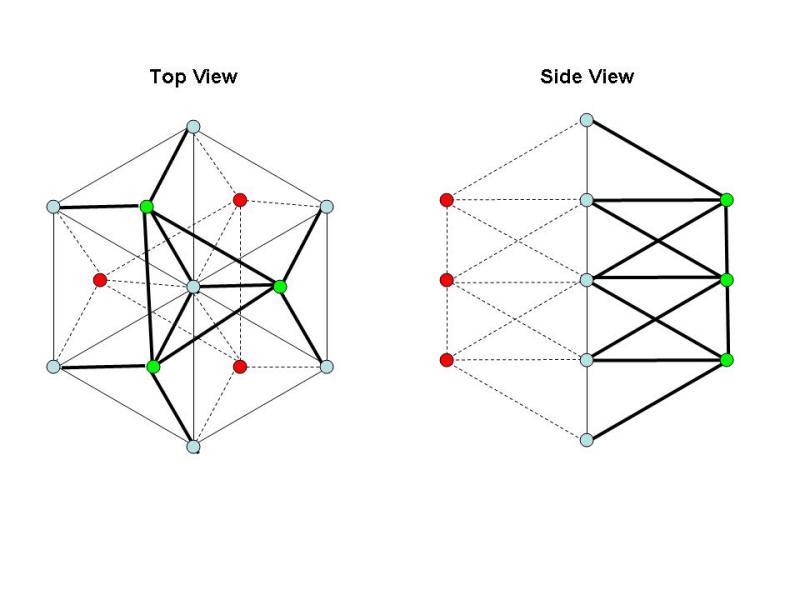 Image from John B | |
| One way to get 12 wormholes close to a central point to minimize transit times | |
A wormhole bus consists of an array of communication-gauge wormholes used to link remote parts of megascale brains in order to avoid information transit time delay. Such an array can also mitigate the effects of the Beckenstein Bound inside a megabrain.
Because some Intelligent Super-Objects (ISOs) are so large that they are several light minutes across (or more), a message from one side of such a structure will take a considerable time to pass from one side of the object to the other. This imposes a limit on the speed with which a very large ISO can process and integrate all the available data. But passing information through a wormhole can reduce the time that information takes to pass across the width of such an object, and increase the processing speed.
Only a Hayward-type wormhole can be maintained within close proximity to the computational infrastructure of a megascale brain, but these small wormholes require much larger amounts of Averaged Null Energy Condition (ANEC)-violating exotic energy.
Wormhole buses are an essential part of archailect architecture. The term is also used to refer to wormhole links between interstellar-separated dyson nodes, and even the interstitial wormholes in a distributed W-Brain.
Related Articles
- Bekenstein Bound
- Bremermann's Limit
- Chronology Protection - Text by Anders Sandberg
The universe seems to counteract attempts to produce time machines, for example due to Visser decay and related vacuum phenomena undermining other forms of time communication. Although the strict Chronology Protection Conjecture by the information age physicist Hawking was subsequently disproved, the chronology protection theorems of Lang, Picard and Joel-5 showed that this tendency can be explained from the consistency theorems, information physics and (eventually) vacuum physics. - ISO (Intelligent Super-Object)
- Matrioshka Brain
- Matrioshka Hypernode
- Stargate
- Visser Effect
- W-Brain, Distributed Wormhole Brain
- Wormhole Nexus, The
- Wormhole Termini
- Wormholes - A Layman's Guide
- Wormholes - Cultural Factors
Appears in Topics
| Archailectology | Communications | Computronics |
| ISOtech | Megascale Engineering | Metric Engineering |
| Space-Time Engineering | Transapientech / Godtech / Clarketech |
Development Notes
Text by M. Alan Kazlev, with additions by Steve Bowers
Initially published on 12 December 2001.
Initially published on 12 December 2001.






