
BY LETTER
Saturn

Galactography > Regions of Space > Inner Sphere
Galactography > Other Major Polities, Empires, and Meta-Empires > Solsys Organisation
Galactography > Other Major Polities, Empires, and Meta-Empires > Solsys Organisation
Ringed Planet in the Old Solar System | |
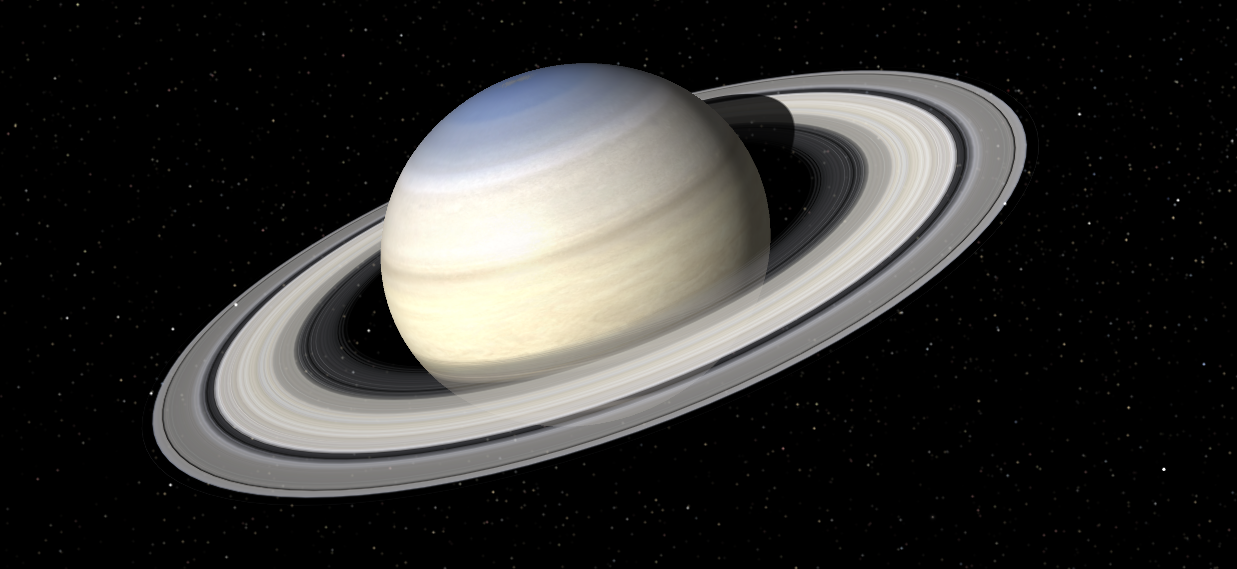 Image from Steve Bowers | |
| In the Current Era Saturn's rings have been restored to their former glory, using the disassembled material from several minor moons. | |
Population: 2.1 trillion sophonts (46% ai and upload, 27% nearbaseline and rianth humans, 2% human superiors, 5% provolves, 11% vecs, 5% cyborgs (usually human-based), 2% sapient structures (bubblehabs, orbitals, arcologies), 3% neogens). Outside the official census are many undocumented modosophonts in the Deeps of the planetary atmosphere. The majority of these are probably ai entities associated with Saturn's native S3 transapient, but others are descendants of Dropout bubblehab dwellers that are either sheltered by or tolerated by that being.
Government: No single government represents Saturn in the Solsys Organization. A complex network of agreements, over and above the Solsys Organization's governance, regulates trade and travel and territory between the hab networks, individual habs, and various collections of freeholds. Some very large alliances along clade and cultural lines apply within the region. Representations to the Solsys Org are negotiated individually. In the rare case that local relationships break down, the local entities typically refer the issue to the Solsys Org for mediation. Negotiations are complex, even with mediation, and have been known to drag on for centuries. Though there is huge variety in the affiliations of the people and polities on and around Saturn, a recurrent theme is an affinity for one or more of Saturn's past ages. The Saturnian region is overall one of the more conservative and conservationist in the context of the overall Solsys Org, and clades and cultures long extinct elsewhere may still be found either in their original form or as re-created in later ages, with varying degrees of accuracy, by historical enthusiasts.
This picture of Saturn's governance applies only to the moons, orbitals, and the upper reaches of Saturn's clouds. Deeper inside Saturn's atmosphere is another region entirely, beneath what is known as The Veil. It is understood that beneath The Veil there exist a number of isolationist and semi-hider cultures, distant descendants of the ancient Dropout cultures, and an even larger number of virtual and AI entities of various toposophic levels. The Veil is maintained by a mysterious S3 transapient, known by a variety of local names, who has occupied the Deeps since late Integration times. This being is highly reclusive, but based on reports from other transapients E is said to be in regular communication with GAIA, though the nature of the relationship between the two is not clear. Subtle influence from that being is quite possibly the reason behind the diffuse governance and the tendency towards Authenticist Restorationism in the myriad polities of the Saturnian region.
 Image from Steve Bowers | |
| An Interplanetary Age bubblehab in the atmosphere of Saturn | |
Orbital Space: Though it is as busy and dynamic as the region around any of the heavily settled Inner Sphere gas giants, Saturn's orbital space is best known for its abundance of historically important habs. A few of these date all the way back to late Interplanetary and early Federation times. The ancient hab of New Antioch, a major regional influence in the recovery from the Solsys Dark Ages, survives to this day, though its original habmind emigrated several millennia ago. Almost as old are some of the Institute for Primate Provolution's historic holdings such as Prime Habitat, Kasekala, the various smaller habs such as Goodal, Galdikas, Fossey, and Jolley, and even its three great Bishop Rings at Saturn's trailing Trojan, Atlantis, Mu, and Lemuria, all now relegated to museum and relic status. The Institute for Vec Progress has sold or converted most of the numerous habs that were built for refugees during the Version War, but retains a memorial of those times in a hab known as The Shrine of the Adamant Martyrs; it is a popular site for visits by vec visitors to Solsys. Another interesting historical hab is Echo Two, the old headquarters of The Refulgence, the society that touched off Solsys' Authenticity War during the Age of Re-Evaluation. The old cult is long extinct, but the hab itself is still in place in its symbolically retrograde orbit, and has been chosen as the coordination node for the ongoing and painstakingly accurate restoration of Saturn's rings. A very significant portion of Saturn's orbital population consists of tourists, scholars, and pilgrims living on temporary visas, many of them in temporary bodies or as scions. Every year a small percentage of these gain permission to remain, to the ongoing consternation of the region's many preservationists. Most recently a small group of Jade Chime Singers secured permission to refurbish one of the derelict orbitals and modify it to their own environmental requirements, with a 300 year lease.
 Image from Steve Bowers | |
| Before their restoration Saturn's rings were reduced to just a shadow of their former glory, due to industrial exploitation over ten thousand years | |
History: The glorious rings of Saturn were used in innumerable images and graphics as a symbol of planetary exploration, and as a shorthand for space itself; a simple ringed planet icon based on Saturn is used in many writing and ideographic systems and in heraldry. The dusty rock in the rings was in some ways the most valuable, as it was used as ballast to generate energy from the Saturnian magnetic field using electromagnetic tethers. Unfortunately this process de-orbited the solid material from the rings (which were only ten metres thick), and this material was lost forever into the giant planet. Meanwhile the deuterium and helium isotopes were being extracted for fuel, and the depleted water ice was used for propellant and life support throughout the outer system. By the time of the Version War the rings were mostly gone.
In order to recreate their former glory (and to facilitate more energy generation and ice extraction) a number of icy satellites have been moved within their Roche limit over the last few millennia and the rings have been restored.
Back to Solsys
Related Articles
Appears in Topics
Development Notes
Text by Steve Bowers
Updated 6 November 2021 by Orion's Arm Editors
Initially published on 31 December 2007.
Updated 6 November 2021 by Orion's Arm Editors
Initially published on 31 December 2007.






