
BY LETTER
Penglai

Galactography > Regions of Space > Inner Sphere
Galactography > Sephirotic Empires > Sophic League
Galactography > Systems and Worlds > Systems & Worlds O - P
Galactography > Sephirotic Empires > Sophic League
Galactography > Systems and Worlds > Systems & Worlds O - P
Sigma Draconis colony settled by Chinese colonists. | |
 Image from Steve Bowers | |
| The shadow of Penglai falls upon Qinglong about twice every local year | |
Penglai Data Panel | |
| System: | Sigma Draconis |
|---|---|
| Primary Planet: | Qinglong |
| Planet Type: | Gas Dwarf |
| Distance from Primary: | 0.845 AU |
| Year: | 0.843 earth-years |
| Radius: | 20,937.259 kilometres |
| Obliquity | 28.03° |
| Colonised | 678 AT |
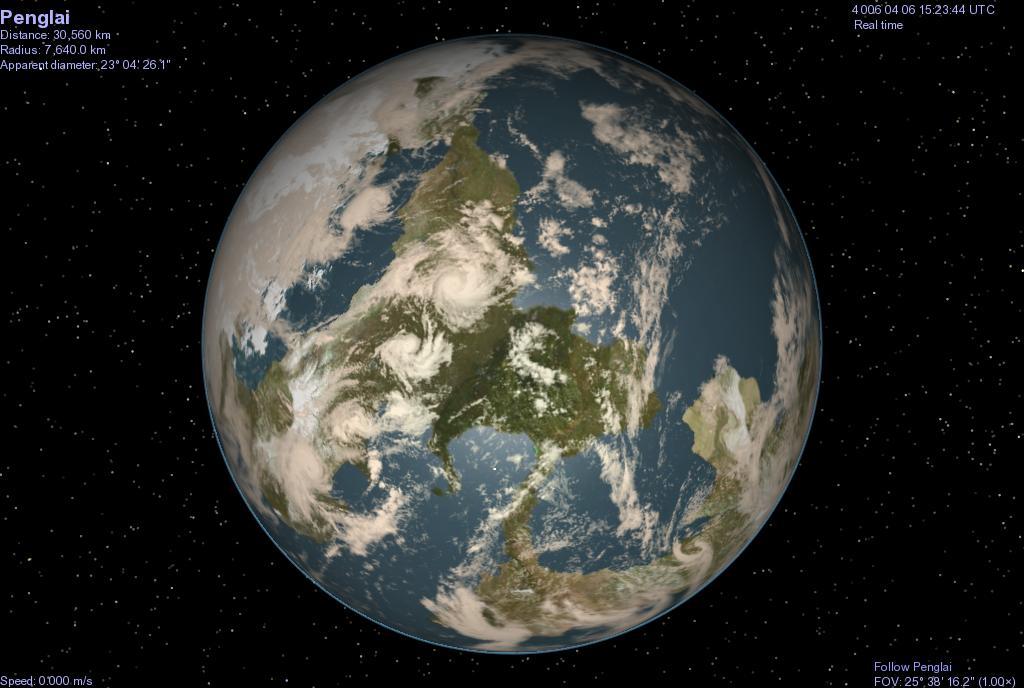 Image from Steve Bowers | |
| Penglai has been successfully terraformed despite its slow rotation | |
The Moons of Qinglong | |
| Fangzhan | Semi-major axis = 114,929.501 km, Orbital period = 1.296 days, Eccentricity = 0.0041, Inclination = 0.040°, Mass = 2.201e+22 kg, Radius = 1,293.661 km, Albedo = 0.198 |
|---|---|
| Yingzhou | Semi-major axis = 182,439.211 km, Orbital period = 2.591 days, Eccentricity = 0.0101, Inclination = 0.471°, Mass = 1.101e+22 kg, Radius = 1,025.443 km, Albedo = 0.164 |
| Daiyu | Semi-major axis = 289,604.196 km, Orbital period = 5.183 days, Eccentricity = 0.0015, Inclination = 0.195°, Mass = 2.215e+22 kg, Radius = 1,294.122 km, Albedo = 0.373 |
| Yuanjiao | Semi-major axis = 459,718.006 km, Orbital period = 10.366 days, Eccentricity = 0.0069, Inclination = 0.281°, Mass = 1.651e+22 kg, Radius = 1,154.513 km, Albedo = 0.595 |
| Penglai | Semi-major axis = 730,000.000 km, Orbital period = -20.731 days, Eccentricity = 2.285e-5, Inclination = 156.826°, Mass = 6.417e+23 kg, Radius = 3,412.267 km, Albedo = 0.430 |
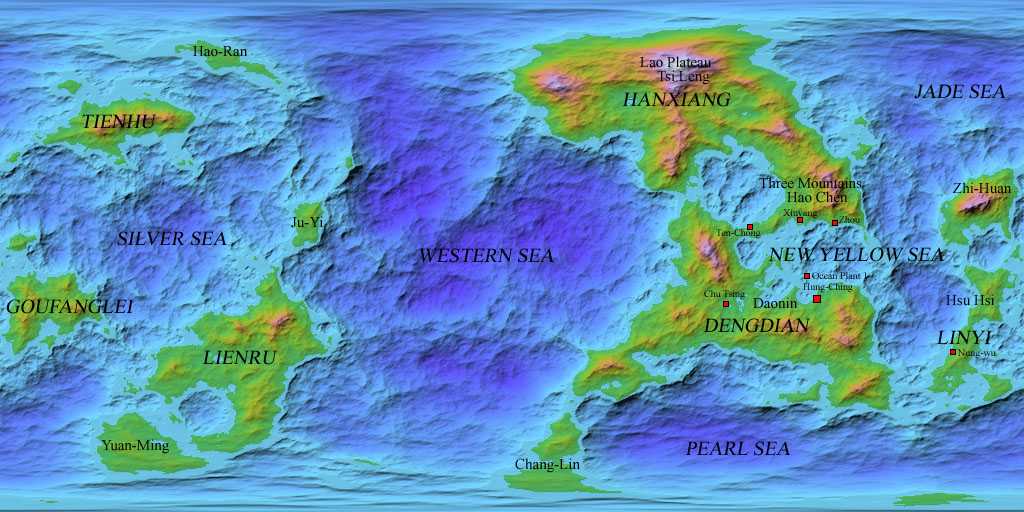 Image from Anders Sandberg |
Penglai; physical characteristics | |
| Surface Gravity | 0.375 gees |
|---|---|
| Day Length | 20.731 standard days |
| Orbital Inclination | Penglai orbits Qinglong in a retrograde direction, since it was captured many hundreds of millions after the formation of that planet. The actual inclination is 156.826°, so the retrograde tilt of Penglai's orbit is 23.174°. Since Qinglong has an obliquity of 28.03°, this gives Penglai an effective inclination of about five degrees with respect to the local star. Eclipses are not infrequent and occur about twice every Qinglong year. |
Contents
Early HistoryThe Jian Dynasty Period
The Dirty War
The Cinnabar Alliance
The Federation Period
The Hsien Ascendancy
The Penglai Empire
Penglai Today - Institutes
Early History
The first colonization mission to Penglai was mostly funded by Heavenly Palaces Incorporated (H.P. Inc.) and its associated partners. Because H.P. Inc. had access to vast He3 resources, major investments by wealthy groups, and an alliance with several Genetekker factions, the value of its stock made it one of the top 10 richest commercial entities in Solsys. The corporation used its wealth and power to fund major interstellar colonization projects together with its Genetekker allies. These colonization projects included construction of an elaborate pellet stream system and a mission to Sigma Draconis. Sigma Draconis drew a lot of interest due to the detection of an apparently Earth-like moon orbiting the Gas Dwarf world Qinglong, known as Qinglong V.Long range observations indicated that Qinglong V had a relatively thin atmosphere like that of Archaean (early Precambrian) Earth. Scientists were divided as to whether this indicated an absence of life or a rich anaerobic eco-system. In any case, spectroscopic evidence and computer simulation indicated that the world could be terraformed given enough time and sufficient economic investment; in fact, terraforming might have been easier and quicker than Mars. This was the decision behind Heavenly Palace's choice of sending a colonization effort to Sigma Draconis. The Penglai colonization mission consisted mostly of baseline Ethnic Chinese, Cislunar, Martian, and Genetekker clades. One of the most important Genetekker clades was the clade Ch'i Hai (Sea of Ch'i or Sea of Life-force), who consisted largely of Taoist transhumanists who sought to genetically engineer themselves for maximal vitality and longevity.
The colony ship Tianzhou 1 was launched in 501 AT, with further missions in 511, 521, 531 and 563 AT. Propulsion was via a relatively primitive boostbeam system, using a stream of mass-driver-launched pellets and and a large plasma-sail. The Clade Sea of Ch'i representatives volunteered to act as stewards for the ship's active minimal- ecosystem. Piloting and maintenance was done by automated systems, overseen by the Heavenly Palaces crewmembers on rotating shifts (2 years on, 20 years off). The Orbital high-tech crew shifts resented the numerous Genetekker modifications to the living quarters of what they considered "their" ship, and the lo-tech but hi-yogic Clade Sea of Ch'i shared the general Gengineer/Genetekker contempt for anything Orbital. The two factions had lukewarm relations at best, and politely stayed out of each other's way in a manner of mild mutual contempt.
It was during somewhat early in the voyage, when the ship had left the outer limit of the Sol System Oort Cloud, that one of the Genetekkers, Michael Qian Ganymede, had a vision (although he always claimed it was a concrete experience) in which the eight Immortals appeared to him and told him of the new world they would settle, and the many difficulties that would be faced before they became a mighty empire.
The Tianzhou 1 arrived in 678 AT. Master Michael Qian Ganymede, now a senior member of the mission subclade, was by this time over two centuries old, although his tweaked constitution, symbiotic medial organisms, and cybernetic organ replacement had kept his body unusually youthful and supple, and in appearance he looked no more than a healthy middle-aged baseline human male. Whereas the Heavenly Palaces Corporation had already named the fifth moon of Qinglong New China, Ganymede and his followers insisted the moon be named Penglai after the paradise island of the immortals. However, Penglai proved to be not quite as earth-like as the long-range probes had indicated. The air was allergenic due to immune system response to local micro-organisms, and the indigenous bio-chemistry was incompatible with terrestrial life.
The first task was building a communications link to Sol and using the ship as a temporary orbital base above Penglai. In addition to Qinglong there were three other Neptunian-type planets in the system, Zhuque, Baihu and Xuanwu. There was some disputation between the Genetekkers, the non-Genetekker Jovian League reps, the Heavenly Palaces administration, and the other mega corporations as to who would lay claim to the resource of these icy worlds. This contention among these factions would continue for at least several decades.
A scouting party sent down to the surface discovered an abundance of anaerobic bacteria belonging to several very distinct phyla and a DNA-analogue genetic structure, but metabolically not unlike the thermophiles and methanogens of Earth. Immediately a heated argument began among the colonists over whether they had the right to annihilate an entire biosphere and replace it with their own. The ecologists, headed by Mission 2nd-in-command Dr Phileus Chang, wanted the Penglaian biosphere left intact and suggested instead construction of permanent orbital habitats along the O'Neill line. The Genetekkers were happy with this; they had spent most of their lives in space so it would not be a radical step. However, some of the Chinese and Martian colonists were upset at this decision since they joined the project in hopes of terraforming Penglai.
By 693 AT the first two ships were in orbit around Penglai, and four semi-independent orbital habitats were constructed using material mined from the smaller moons. These semi-independent colony habs would be jointly managed by the representatives of the Heavenly Palaces and the Genetekker biocorps. It was a giant social experiment, based on a sort of hopeful compromise between the corporate bureaucratic management, the more spontaneous attitude of Clade Sea of Ch'i, and the squabbling needs and wishes of the colonists themselves. In time, the local Heavenly Palaces admin came to deeply rue the deal their parent Corporation had made with the Genetekkers and the other corps, who in turn chafed at the fearful cautiousness and "inferior man" policies of the Board, and the colonists meanwhile insisted on setting up their own governments with bioregional e-democracy based on the system they knew at home. Problems including lost transports, language confusion due to different dialects, resource shortages and unregulated movement complicated things seriously. The local governments gradually became more and more independent, despite the attempts by Heavenly Palaces management to keep everything on track.
In 712 AT a few disjointed messages arrived from surviving habitats in Solsys; news of the widespread destruction from the Technocalypse and the Last War on Earth led to uncertainty and anxiety. Heavenly Palaces suffered less than some of the orbital conglomerates, thanks to blue goo shielding, all of whom were doing better than the Earth-bound corporations, almost all of which had ceased to exist as functioning units. There would also H.P. executives immigrating to Penglai as they had ordered the early launch of an incomplete ship originally planned for elsewhere. The vessel lacked either an ecosystem or industrial seed, so they decided to head to an already established system.
At Sigma Draconis the local colonial management was in crisis mode. Factions developed, the split being between company loyalists (representing the main administration) and young turks under Jian Hsin who had the support of Clade Sea of Ch'i and most of the colonists in wanting to declare independence. Meanwhile, Clade Sea of Ch'i had in turn split, with Michael Qian Ganymede declaring his support for Administrator Jian Hsin, while the Jovianist faction wished to colonize the icy outer worlds.
In 715 AT Jian's faction led a bloodless coup. On attaining power, they called themselves Penglai Colony Administration (PCA), with Jian himself as First Colony Administrator and Michael Qian Ganymede as Sage-Advisor. The old leadership was placed under indefinite house arrest. Riding on the wave of popular support and independence following their unilateral declaration of independence, Jian Hsin (or Jian-tze as he now liked to style himself), leader of the new PCA, made the former districts of Hao Chen, Daonin, Tsi Leng and Hsu Hsi into sovereign nations, and they were formally recognized by the PCA. The PCA retained control over the defense forces and acted as a kind of UN with enforcement powers. Under an agreement of alliance, the other corporations were given ownership of most of the large Draconis Belt, while the Jovianists were allowed one of the colony ships and the ice giant moons, along with He3 mining rights.
Meanwhile sporadic and doom-laden transmissions from Solsys created a climate of fear. The local Internet buzzed with rumor and speculation, and every incoming piece of information was scrutinized, amplified, and commented on. Partly because of this fear, Jian hoped to build a powerful fleet to protect the Sigma Draconis system, but social problems, cultural clashes, and petty rivalries slowed things down, to say nothing of disagreements about the best design to use (especially after the original plan to convert some of the colony support vessels to fighters and light cruisers proved impractical), and after ten years they still did not have a single ship ready. Meanwhile the colony ships were being used as Standard Interplanetary Operations type ships to explore the ice worlds and outer asteroid belt and set up habitats there.
 Image from Steve Bowers | |
| Penglai at night | |
The Jian Dynasty period
In 773 AT the Jian Family announced that the Penglai Colonial Administration was now a hereditary dynasty, hence-forth to be called the hereditary Jian Dynasty. The bionano-yogic Michael Qian Ganymede, disgusted with the such Machiavellianism and the increasing bureaucracy, broke with the Jian Family and retreated with his followers to Linyi island, YangkoDuring this period, the surface-based Daonin and Hsu Hsi were the most successful nations, while Hao Chen (located on the mountainous Three Mountain Peninsula) became involved in a succession of internal conflicts, corruption affairs and outbreaks of violence, and Tsi Leng on the mineral-rich but cold-dry Lao plateau had a hard time developing its potential. To compound the problems the new nations included colonists from several different backgrounds, making communication difficult. Despite the fear of backyarders and nanotech destabilization from Earth there was a lot of rivalry, dissension, and administration problems on Penglai. The Dynasty administration several times had to organize action against deserters who in response to the allergens, tried to engineer ready-made bio-organisms that would interfere with and further disrupt the already difficult process of terraforming.
The core of Penglaiese politics at that time was the guanxis. A guanxi is a personal network, a bit like old school ties but with stronger Confucian and hierarchical implications. A subordinate friend is obliged to help his superior in all things, and can expect the help and protection from the superior. Certain guanxis become extremely powerful, ranging over the whole colony and enabling the leading members to influence just about everything through their widely distributed net of obligations. The PCA had originally tried to prevent this by setting up the four sub-colonies in isolation from each other, but the result was that guanxis gained much stronger local control (an additional factor to their independence), and once the policy was softened guanxis began to spread internationally. For anybody to rise above the national political level they needed support from the international guanxis, which by then dominated the PCA.
The Jian Dynasty always thought big. The various projects instituted from the start consumed tremendous resources, but also became useful rallying points for the different colonies. The atmospheric modification units in the New Yellow Sea and on the Lao plateau converted carbonates into huge amounts of carbon dioxide to warm the planet, while a great orbital catapult was constructed near Daonin. Another area where Penglai developed was materials science; the Daonin project and the needs of the colony necessitated the development of light, strong, flexible and cheap materials. In time designer materials became a major product, including smart materials with noticeable computing power, ultra-strong composites and moving gels.
 Image from Anders Sandberg | |
| The PCA hospital at Pen-Yu in Hao Chen. The hospital complex, built during the early colonisation effort, was deliberately built to withstand extreme weather and major loading. It has submarine hangars to deal with causalities from the Yellow Sea projects, and was equipped to act as a local disaster relief centre. While these functions were underused, it also housed the PCA Adaptation Program which co-ordinated the adaptation measures made to help humans adapt to Penglai. The hospital was a major PCA stronghold. During the Dirty War it remained neutral ground, and PCA activities in Hao Chen were coordinated from there. There were rumors that the complex was the headquarters of a secret PCA surveillance progam, but these rumors have never been confirmed. | |
The Dirty War
In 889 the Hao Chen government was toppled by a serious corruption scandal (including sex, murder, abuse of power and many juicy details) leaving a major power vacuum. The Jian Dynasty administration moved in too late, several dissenting fractions jockeyed for power and the "compromise government" the Dynasty set up found itself opposed from all directions. Over the span of a few years it weakened more and more, despite strong Dynasty support, and in 893 AT the rising level of street violence grew to civil war. The "Dirty War" as it became called lasted just for a few months. The Jian Dynasty used its influence to open the borders of Hao Chen so that anybody who wanted to leave for the other colonies could do so; this quickly bled the Hao Chen economy dry and drained away most of the non-aligned people. Then the Dynasty gave its full support to one of the strongest fractions, the Three Yard Guanxi, and made it the new government. Unfortunately, the émigrés did not all move back as intended to rebuild the land, and a complicated process of semi-forced relocations, changed citizenships and minor terrorism gave the Jian family gray hairs. In the end, some enclaves of ex-Hao Chen people remained in Hsu Hsi and Daonin, in time becoming important in planetary trade and industry despite the imposed borders. Hao Chen slowly recovered, but the government remained shaky. Several times it has fallen, only to be restored after devious maneuvering among the "fractions", the different groups that try to rule the peninsula. To make matters worse, many of these fractions now have complex ties to the other colonies, the underworld, terrorism or even the Dynasty in various ways.The Cinnabar Alliance
Hsu Hsi (originally called Yangko) was where Master Michael Qian Ganymede retreated following his break with the Jian family. When the nation became independent a radical anti-Jian neo-Taoist group, the Cinnabar Alliance, tried to gain power but were rebuffed by the regional government. However, over time they gradually won influence, and in 966 they managed to reach the presidency. One of their first acts was to rename the nation, and then they began a program to undercut Jian influence. The Dynasty, wise of the mistakes it had done in Hao Chen did a surgical political strike against the Cinnabar Alliance, succeeding in removing the leadership and putting a moderate fraction back in power. The other nations supported the move, and in the end the radical reforms were removed, except for a few popular ones like the name of the nation. The strike was unpopular in Hsu Hsi, and added to support for the Hsien. The nation remained both unwilling to submit to the Dynasty leadership and independent right up until the Hsien coup. The large oceanic installations of the Yellow Sea were often based on Linyi, and the island reaped great economic benefits from every new construction regardless of who paid for it.The First Federation Period
The arrival of the Federation of Sophonts was a period of tremendous cultural development for both sides. While the Penglaists gained from the influx of Federation ultra tech and the opening of new trade routes, the Federation renaissance was fascinated by Penglaist ideas, as it was by all the colonies. And among the most influential elements of Penglaist culture to infuse the federation were the various schools and sects of Neo-Taoism.From the beginning, Taoism remained popular, and several schools developed. In addition to the orthodox school of Master Michael Qian Ganymede there was the more intellectual development of researcher-artist named Yuan Guen and his students. This placed less emphasis on difficult and esoteric Chinese yogic practices and more on a synthesis of quietist Taoism (drawing heavily from Lao-tze and Chung-tze), Buckminster Fuller's work and complexity theory. Being more accessible to the intellectual middle management types, it emerged to become an important influence in Penglaiese society, art and technology. While some offshoots resisted the terraforming projects, the mainstream neo-Taoists embraced them wholeheartedly, developing better ways of using a minimal amount of matter and energy to change the planet.
During the early Federation Period, the Jian Dynasty was still going strong. It had become a huge bureaucracy with many departments, officials willing to organize/interfere with the national governments and subtle power-gaming between different guanxis, departments and views. Most of the higher administration was located on the big orbital Shun-Xie, but many departments were in immense bureaucratic archologies on the ground.
The Jian Dynasty's on-going attempts at terraforming the planetary ecosystem, changing it from a reducing to an oxygen atmosphere had not gone well, and even after centuries of terraforming, adapting to Penglai was tricky. The day was too long, the gravity low, the air oxygen poor and often unpleasantly allergenic, due to an unexpected cross-hybridization of local microbes with terraforming organisms; the latter has been called Penglaian's' Revenge. These problems were eventually solved by various medical treatments and some limited genetic modifications of children; even to this star date the Penglaiese today tend to be short, stout, have a longer diurnal cycle and are highly resistant against many allergens. However, these measures were less implemented in certain districts, and other solutions such as exoskeletons were also used. The neo-Taoist purity ideals contradict the adaptation ideas; there have been fierce debates on whether the modifications are a dangerous pollution of the bodies of the citizenry. In the end, the neo-Taoists split into a spectrum ranging from the small "School of Inner Alchemy" (derived originally from Master Michael Qian Ganymede which thinks that all the changes are negative and should not be given to children, and the more liberal "School of Outer Alchemy" which claims these changes really are part of the Way. An even more extreme group, the Hsien, claim further enhancements are the Way, but this view was disliked by most of the population. Overall, even today, the Penglaiese value purity and perfection highly. A spotless design, a clean room, an illustrious career is regarded as ideals to strive for.
During the Federation Period the problem of the long day was addressed using an early form of Weather Machine system. Large numbers of small, transparent spheres filled with lifting gas were lofted into the upper atmosphere, each of which held an integral steerable mirror. Sunlight falling on the daylight side was reflected and re-reflected by these mirrors until it reached the night regions, warming the dark hemisphere and cooling the day hemisphere. This system is still in use on Penglai, although modern weather machines use phased-array technology instead.
The Hsien Ascendancy
The Hsien, "the Immortals", began as a movement with libertarian, transhumanist, Genetekkerese, and neo- Taoist elements whose members often had strong bionano augmentation. This movement created a culture with a focus on the individual, in contrast to the mainstream hierarchical Penglai society. A major area of conflict between these cultures regarded genetic engineering. Originally a group of quite diverse radical neo-Taoists in Hsu Hsi, Daonin and on some Qinlong orbitals, they were suppressed by the Jian dynasty when they broke against the genetics laws to improve themselves. The Jian Family however had no jurisdiction over the gas giant orbitals, and they continued their culture there. Their core belief was that the human body and mind can be perfected by neo-Taoist principles, genetic engineering, symbionts and training. The Jian's suppression of the Cinnabar Alliance, while popular among the nearbaselines, added greatly to support for the Hsien off-world, and by neo-Taoists on Penglai. By the 10th century the Hsien developed into an underground network working against the Penglai Dynasty and blamed for terrorist activities across Penglai; untangling what is real Hsien activities, unrelated groups, rumors and propaganda proved almost impossible for the authorities. Their secret leader (or leaders) are referred to The Great Sage, Equal of Heaven (a reference to Sun Wu Kong, the rebellious monkey king in Chinese legend who perfected himself and sought to overthrow the Jade Emperor of Heaven).With the arrival of the Federation, the Hsien mystique inspired many romantic and dramatic interactives and other classic literary medias, some of which, like Gen Li tsu's Monkey of Penglai, remain much-loved classics both on Penglai and throughout the civilized galaxy, even in the Current Era.
The rising popularity of the Hsien infuriated the Jian Dynasty, who protested against the Federation and Nova media corporations. But their heavy-handed attempts at memetic censorship only added to the sympathy for the Hsien.
In 1205 AT, with local Jovianist and Federation Genen help, the Hsien managed to organize a bloody revolt. The by now much loathed Jian Dynasty was toppled, and the Xian Dynasty instituted in its place. Despite Federation objections (the Federation had offered the leadership a haven at Cislunar in exchange for their stepping down and avoiding further bloodshed), the old leadership was executed for "crimes against the people".
The Penglai Empire
In the following centuries, under Hsien leadership, the Penglai planetsiders, the belters, and jovianists merged in a solar-system wide empire. The Hsien approach was much more fluid and libertarian than the old Jian Dynasty. While many differences remained, the various factions realised they had more in common with each other than with the Federation, who by the 1500s was seen to be a lackey for off-system megacorps interested only in exploiting their natural resources.More on the Penglai Empire
The Conver Ambi and the Sophic League
After the Conver Ambi gained effective control of the Penglai Empire, Penglai was an important part of the Conver empire; however the Second Consolidation War ended with the destruction of the Conver Ambi empire, and the Sigma Draconis system came under Metasoft protection.After the Version War Penglai was re-assigned to the Sophic League as part of the war settlement, and is now an important Sophic centre for spiritual development.
 Image from Anders Sandberg |
Penglai Today - Institutes
All of the once-vibrant Penglai Institutes are now hide-bound in centuries of tradition, most under hereditary meritocracy or aiocracy Evoltech is a hereditary /Old House consortium selling evolved software, alife and other products of complexity engineering offplanet. It has long-standing links with a number of other old core worlds, including Nova Terran and Unity AI companies and Atlantean micro-trading software.The Association of Free Enquiry began as a scientific association working for academic freedom. Over time it changed, and by the Hsien era it had now become a part of the Penglaiese academic establishment rather as an oversight group and special interest organisation working closely with the PCA Education Department. Since the Age of Consolidation it has been under hyperturing rule.
The Order of I is a neo-Taoist/post-Confucianist/Quasi-Sophist conservative religious group. I is a concept in Confucianist ethics denoting acting right in any situation without any thought of personal gain. They wander around Penglai, preaching neo-Taoism and promoting their own religious values. Many regard them as moral busybodies, more interested in explaining to others what they are doing wrong than changing anything themselves. The movement has some following among ethnic Penglaiese and others throughout the Nexus.
Penglai; Geography | |
| Geography: | Physical: The surface is 70% water, with several fragmented continents; overall the planet is quite mountainous due to the low gravity. The largest continent is Hanxiang on the northern hemisphere, with the extensive Lao plateau (where Tsi Leng is located). It sends out a rocky peninsula called the Three Mountains, the site for Hao Chen (capital Xiuyang). Around the peninsula lies the New Yellow Sea, with many offshore platforms and atmospheric conversion units. To the south lies the continent Dengdian, with Daonin on the extensive coastal plains (capital Hung-Ching) . To the southeast, on the island of Linyi lies Hsu Hsi (capital Nung-wu). The other continents (Lienru, Tienhu, Goufanglei) and major islands are largely uninhabited or set aside as parkland or natural reserves. Climate: The weather is cool, with large icecaps on the poles and few truly warm summers even at the equator. However, whenever the vegetation is dry it can be ignited, and fires are a constant danger even in winter. Biology and Ecology: The indigenous anaerobic ecosystem was completely annihilated by the increasing oxygen content and terraforming activities, apart from a few sealed preserves. The largest of which, Chang Biosphere, is a vast triple-sealed air-tight dome on the East Coast of the Yellow Sea. The surviving lifeforms are all microscopic and microbial, although anaerobic branching stromatolite analogues are common, especially in shallow sunlit waters, and can reach several meters in diameter. The surface layers of Penglai oceans were and still remain very nutrient poor, while most nutrients are found in the depths. Penglai currently has extensive deep sea ecosystems, consisting of immense labyrinths of coral-like bacterial growths that seem to have somewhere hybridised with the terraforming microbes and acquired oxygen tolerance. A few other indigenous microbes seemed to have survived the transition to the oxygen atmosphere, either through an intrinsic tolerance to oxygen or hybridisation with terraforming microbes. For the most part though the Penglai ecosystem consists of introduced Earth-derived organisms. |
|---|---|
| AI | AI overseers: the Heavenly Immortals (Sophic League affiliation) AI's ethos: Encourages Local Culture, Mildly Interventionist, pro-human |
  Images from Anders Sandberg, Steve Bowers |
| Psyche, Art, Culture | Metapsychology and Metaethics: Neo-Taoist, Hsienist, and Sophist elements can all be found Religion/Ideology: Reformed NeoTaoism (official), but Han Jovism, Penglaist Genetekkerism, Sophism, and Cosmosophism are all widely followed Language: Penglaiese (official). Penglaiese Anglish, Chinglish, Douh, Brev, and several derived dialects of Bojiangnese are also among the many languages spoken Aesthetics/Architecture/Style: In architecture, organisation and planning Penglai tends towards the huge and monumental. Everything is built to last, with big safety margins and heavy foundations. At the same time the ideas of neo-Taoist synergetics are prevalent: the immense should be built as elegantly and lightly as possible, often exploiting unusual symmetries and interlocking parts. Combined with a resurgence of traditional Chinese baroque (dragons, ornamental lattices, bodhisattvas etc), Old School Conver Ambi, and Sophic League Iconography, the result is a very unique style mixing old and new, robust with elegant, heavy with light. Personal clothing tends towards the warm and practical. Coats are cylindrical affairs with thick arms, not unlike Old Earth Russian bojar coats. |
|---|
| Territory and Population | Population: Penglai Surface Total - 3 billion. Hao Chen: 1.1 billion. Daonin: 1.0 billion Tsi Leng: 0.5 billion Hsu Hsi: 0.4 billion orbital habitats: 153,262,000. Population breakdown: Surface: Penglaiese tweaks (Homo penglaenisis - low-grav and local biochemistry adaptations) make up 72 percent of the population. There is a smaller number of bioborgs, heroms, vecs, and other groups Orbitals: a combination of baseline/near baseline, genetekkerese heroms, virtual, non-genetekkerese tweak, space-adapted tweak, bioborg, vec, splice, and other races Territories: Penglai, Yue, and Orbitals in Qinglong Space, several minor asteroids Planetary Nations. Tsi Leng is located on the Lao Plateau, which covers much of the continent Hanxiang. The climate is harsh, with cold northerly winds blowing for much of the year and occasional sweeping fires. Still, the plateau is the most mineral-rich part of the planet, with huge resources of everything from copper to rare earth metals. These were extensively mined during the Federation period, but the remaining resources are now protected. Tsi Leng has never had any real capital, since the widespread settlements and outposts were tightly connected through the net; just like on Nova Terra instead a virtual government did as well as a physical. Decisions are made through an invisible virtual bureaucracy where the hyperturing bureaucrats are widely dispersed but connected; it is sometimes jokingly called the Celestial Bureaucracy. While this gave Tsi Leng one of the most flexible governments on Penglai, it has not been enough to get the nation competitive, even at the height of the Penglaist empire. People have whenever possible moved to other nations, orbitals, or worlds, and by the 15th century AT the brain-drain to Daonin became serious. Since the early Age of Consolidation the whole country has retained a rural, faintly neo-primitivist air, and it is a popular spot with traditionalists, ludds, and anti-aioidists. The local administrations sometimes provide token work, there have been little energy or manpower left to develop the potential of the plateau. It is even today an old Penglaiese joke that Tsi Leng is the place where nothing has ever happened and never will. Hao Chen is a rainy, mountainous peninsula. Due to the low gravity the rain splashes higher, making umbrellas impractical. Most cities have at least covered walkways and streets with glass ceilings. At first the sub-colony was quite successful, becoming a major supplier of heavy manufacturing equipment and cultured meat (China had solved the problem of keeping people supplied with protein in the 150s by culturing meat in nutrient tanks instead of as inefficient grazers; this has become a staple on Penglai to a much larger extent than it ever did in China, in fact Penglaiese often prefer cultured meats to natural ones). Following the Dirty War (893 AT), the country became a center of social unrest and on-going headache for the dynasty. The country remained a mess until the Hsien Dynasty managed to restore some measure of order, but social problems remained well into the Age of Consolidation. Since the Integration the area has been only very lightly populated. Daonin is historically the most successful of the nations of Penglai. Blessed with a fairly pleasant climate, good farming and a concentration of the intellectual capital, it was the richest and most dynamic nation. Most of the rains that plague Hao Chen pass right overhead, releasing their water in the interior mountains instead on the coastal plains. Several deep and powerful rivers pass through Daonin, which is still toady often called the Land of Bridges. The capital Hung-Ching is the major city on the planet, with the premier universities, largest corporations and the Electric City, an area where many of the rich and famous have congregated. The Electric City got its name from a popular song in the 1520's; it is a park-like area where unassuming but very, very expensive buildings overlook the canyon of the Ao river. Many people have flocked to Daonin from the other colonies and form important subcultures; in addition the inhabitants are known to be less rigid and traditional than the other nations and take a pride in inventing new outrageous styles. Unlike the other colonies Daonin is fairly conservative and bureaucratic, at least officially. Hsu Hsi (originally called Yangko) is located on the fertile Linyi island in the southern Yellow Sea. It is a nearly flat island, which has some flooding problems when the winds become too strong. Many of the buildings and cities are built on heavy concrete foundations or inside geodesic domes. It was here Yuan Guen worked, and neo-Taoism is also strongest here. The Hsien revolt began here, and during the later Federation period the continent was given preferential treatment and became the planetside center, with the capital Nung-wu. Today the old administrative centers are popular tourist stops. The shrine located on the spot where Master Michael Qian Ganymede is said by popular folklore to have ascended bodily into posthumanism, and serviced by several local monasteries, is another spot worth visiting. |
|---|
 Image from Anders Sandberg | |
| Penglai Surface | |
| Immigration: | Immigration: currently 1.5 million per tenyear Emigration: currently 5 million per tenyear Immigration laws are very strict on the surface, little less so in the Orbitals. |
|---|---|
| Government and Administration | Government Type Representative Cyberdemocracy under mild hyperturing supervision Administrative divisions: Terrestrial and Planetary Provinces with limited local autonomy National holidays: A number of local festival dates Constitution: Penglai Charter of Polityhood (Sophic) - this being an update of the previous Hsien version Legal system: Standard Sophic League law applies, with local modifications Foreign Policy: Good relations with other Old Core worlds, with the Sophic League, and elsewhere |
| Economics, Local Infrastructure | Economy: Sophic Socialism Currency: Penglaist Yuan. The various nations and orbitals have their own scrips of lesser value. Major Industries: alife, tourism, virches, personality constructs, memetic templates, wetware, pharmopoetics, bioborg parts, persona compoids, crude organobiota. Angelnetting : In some surface cities and a number of orbitals Major Orbitals: Shun-Xie, Jade City, several smaller orbitals |
| Travel | Major Spaceports: Michael Qian Ganymede National Spaceport (Shun-Xie) Hazard Rating : 0.0 to 0.2 Visa Restrictions : none (non-permanent residence only) Freedom of Movement : no restrictions on travel Environmental Requirements : Due to weather extremes and local microorganisms, Penglai Surface is not comfortable for un-tweaked baselines Sites of Interest: see note on planetary nations for some surface sites to visit |
Related Articles
- China
- Chinglish - Text by M. Alan Kazlev
First Federation era hybrid language derived from Anglic, Mandarin and Cantonese, and spoken by ethnic chins. Today it is only found in House Chin, where it is used for formal occasions, among a few ethnolazurogenic clades, or as a novelty language (like Latin, Esperanto, Vzzman, and other dead languages). - Chins, Chinis
- Genetekkers, The
- Huanghua
- Penglai Empire, The
- Penglai Slang
- Shenjing (Sigma Draconis) System
- Sun Wu K'ung (fiction)
Appears in Topics
Development Notes
Text by Anders Sandberg and M. Alan Kazlev
Updated by QwertyYerty, Radtech497, Steve Bowers 16/9/17
Initially published on 23 July 2000.
Updated by QwertyYerty, Radtech497, Steve Bowers 16/9/17
Initially published on 23 July 2000.
Additional Information
Fiction featuring Penglai
Traveler's Notes - Penglai
Traveler's Notes - Penglai






