
BY LETTER
Interplanetary Transport

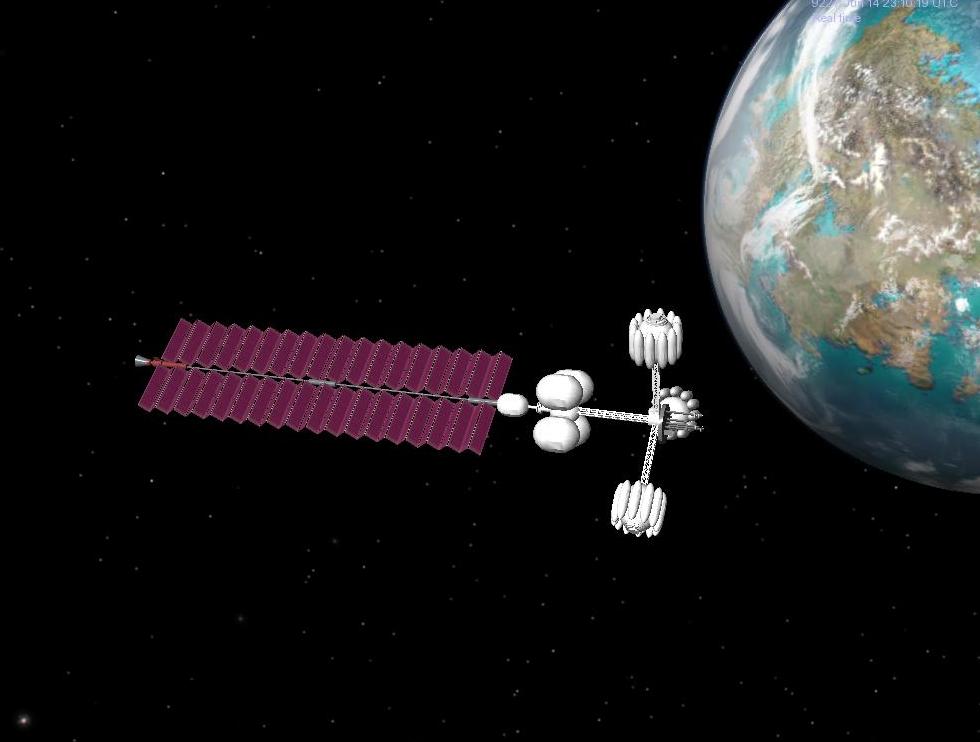 Image from Steve Bowers |
Interplanetary transport includes the spacecraft and technologies for moving passengers and cargo from point to point within a star system or the immediate environs of a star system up to a distance of about half a light-year. At distances greater than this, transport systems are generally considered to be interstellar class, although craft or systems able to move between the widely separated components of some multiple star systems (for example the components of the Kiyoshi pentad) are also usually included under the "interplanetary" classification.
Articles
- Aerospace Engineering - Text by M. Alan Kazlev, modified from the original write-up by Robert J. Hall
A field of engineering that combines aerodynamics, fluid dynamics, propulsion, thermodynamics, aerospace mechanics, virch simulations, materials science, energy use, nanofabrication and vehicular structures. - Antimatter Catalysed Fusion - Text by M. Alan Kazlev and Steve Bowers
Propulsion using fusion boosted by relatively small amounts of antimatter. - Antimatter Propulsion - Text by M. Alan Kazlev, Mark Mcamuk, Chris Shaeffer, updated by Ithuriel (2015)
Propulsion using antimatter rockets. - Arcjet - Text by M. Alan Kazlev
Simple very lo-tech rocket used for short low power thrusters, such as station keeping motors and satellites. A non-flammable propellant is heated (not combusted) by an electrical heat source, causing it to undergo a phase change (from liquid to gas) and is then expelled out of the nozzle under pressure. Although extremely inefficient and low thrust, arcjets are very reliable and require no sentient or subsentient ai controller. Almost any fluid from spare drinking water to human urine to vec cleaning oils can be used as a propellant in an emergency. - Bioship - Text by Steve Bowers and M. Alan Kazlev
Bioships are either grown partially or entirely using biotechnology or by a close analogue to biological growth: they can be very similar in final composition to other ships but often look distinctively 'organic' in form. - Boostbeam - Text by Todd Drashner
Mass-beam based system used to accelerate or decelerate spacecraft without the use of onboard reaction mass. - Cargo Ships - Text by Steve Bowers and Damon Court
Freighter spacecraft. - Crescent Class Cruiser - Text by M. Alan Kazlev and 'Total Annihilation'
A 15th to 17th century combat spaceship of dramatic and eccentric design. It is long obsolete but is popular in the present era among wealthy historical weapons enthusiasts. - Cycler - Text by M. Alan Kazlev
A cycler is a ship or mobile habitat that travels continuously along an orbit or interstellar route in such a way that it makes a regular series of rendezvous with other stations, orbitals, planets, or stars along the way. Cyclers may be small or large, sparse or luxurious, slow or fast. They may be interplanetary (also called an Aldrin Cycler) or interstellar (also called a Schroeder Cycler), and may be completely passive (simple ballistic orbit) or may have course-correction drive units. - Dragonfly Class ship - Text by Steve Bowers
Interplanetary and interstellar spacecraft developed in Solsys during the First Federation; it was used as a pursuit ship in anti-piracy operations, as a System Control Ship in the Eridanus League, and on occasion as an interstellar craft for journeys of twenty light years or less. - Dreadnought (ship) - Text by M. Alan Kazlev
A Capital Ship of the largest scale (term now rarely used). - Electric Propulsion (Ion Drives) - Text by M. Alan Kazlev and Steve Bowers
Propulsion using electrical energy to obtain thrust - Exoatmospheric - Text by M. Alan Kazlev
Vehicle or tweaked life-form capable of operating both in a vacuum and in an atmosphere. May be planetary- or space-based. - Explorer Class - Text by M. Alan Kazlev
Long range, rugged and reliable self-repairing amat-powered exploration vessel used during the First Federation period. Some remained in service as late as the age of Expansion, and even today Explorer Class vessels little different from the original design are popular among many minor and independent clades, especially in the outer volumes. - Fission Drives - Text by Mauk Mcamuk, Chris Shaeffer and M. Alan Kazlev
Propulsion using nuclear fission as a power source. - Fusion Plasma Rockets - Text by Luke Campbell
Propulsion using nuclear fusion energy. - Gravity Tug - Text by Alex Mulvey and Steve Bowers
A method for moving an object such as an asteroid without touching it, using the gravity and thrust from a spacecraft. - Nuclear Pulse Drives - Text by M. Alan Kazlev, Mauk Mcamuk and Chris Shaeffer, updated by Ithuriel
Propulsion using explosive pulses of plasma external to the spacecraft - Omnicraft - Text by Todd Drashner
Versatile mode of transport designed to operate and provide accommodations in a wide range of environments from planetary surfaces to interplanetary space. - Pacman Miner - Text by James Ramsay and Steve Bowers
Asteroid Mining Ships. - Plasma Magnet Drive - Text by Tardigrada
The plasma magnet uses a low mass generator to produce large-scale magnetic fields. This is useful for various applications, most notably in spacecraft propulsion in the form of the plasma magnet drive(PMD). - Podship - Text by Thorbørn Steen
A passenger spaceship that emphasizes short transit times at all costs; the engine is the fastest that the technology of the maker allows and passengers travel as inactive data to save mass. - Propulsion Performance Statistics - Text by Mauk Mcamuk and Chris Shaeffer
Statistics for various kinds of Propulsion Technology used in the Orion Arm - Pyrenian Klarion Explorer Seedship - Text by Thorbørn Steen
A data-only podship exploration design. - Ramscoop and RAIR ships - Text by Steve Bowers, Tim Weaver and Todd Drashner
The Bussard Ramscoop concept, Ram Augmented Interstellar Rocket ships and other Magnetic Scoop devices. - Reaction Mass - Text by M. Alan Kazlev, Richard Baker, and David Dye
Fuel used by a conventional rocket ship. - Rotovator - Text by Steve Bowers
Device for transferring cargo or passengers from the atmosphere or near surface of a planet to outer space. - Ship Style and Decoration - Text by M. Alan Kazlev and Anders Sandberg; additions by Steve Bowers
Among the different interstellar empires and colonies, ship design and outer decoration varies widely. - Shipyards and Spacecraft Repair Facilities - Text by Ryan B, Todd Drashner, rom65536, Steve Bowers
Shipbuilding and spacecraft repair facilities. - Solar and Microwave Passive Propulsion - Text by M. Alan Kazlev
Sail propulsion using reflected photon pressure. - Solar Moth - Text by Steve Bowers
Solar Thermal Rockets use sunlight to heat propellant. - Space Hulks - Text by M. Alan Kazlev
Deserted shipwrecks in deep space, some becoming habitats for hider clades. - Subrelativistic - Text by M. Alan Kazlev
Pertains to any interstellar ship, fleet, cargo pellet, or other object travelling at a reasonably slow rate (say 0.01 to 0.1 c) so that time-dilation and other relativistic effects do not become evident. Subrelativistic vessels may take centuries to bridge the gap between even nearby stars. - Sun Scutter - Solar Thermal Bioship - Text by Rhea47
The Sun Scutter is a type of low speed interplanetary bioship powered by a solar thermal rocket. - Thermal Rockets - Text by Mauk Mcamuk, Chris Shaeffer and Steve Bowers
Fuelless rockets driven by an external heat source. - Thicksuit - Text by Todd Drashner
Nanotech/bionanotech vacuum survival suit. - Thruster Pack - Text by Todd Drashner
A compact propulsion unit used for individual operations in free-fall environments. - Torch Drives - Text by Luke Campbell with updates from Ithuriel
External plasma drives. - Tricorn Ship - Text by Steve Bowers
Interplanetary or interstellar ships that use a tension design. - USS Randolph CSGN-04 - Text by Aaron Hamilton
The USS Randolph was the first of a class of powerful (for the time) interplanetary cruisers built by the United States of America to reassert past military dominance. - Yi Sun-Sin (System Control Ship) - Text by Aaron Hamilton, adapted by Steve Bowers
The Eridanus League used System Control ships like the Yi Sun Sin in an ultimately futile attempt to maintain order and cohesion over worlds many tens of light years apart.
Related Topics
| Atmospheric Transport | Classic Ships | Interplanetary Transport |
| Interstellar Transport | Liquid Transport | Propulsion Technology |
| Ships | Subsurface Transport | Surface Transport |
| Surface-To-Orbit Transport |
Development Notes
Text by Todd Drashner
Initially published on 31 December 2007.
Initially published on 31 December 2007.
Additional Information






