
BY LETTER
HyperthermalJovian Type

Very hot gas giants, with temperatures above 1400 Kelvin | |
 Image from Steve Bowers | |
| Behemoth, Hat-P-1b, a dark, puffy planet, compared in size to Jupiter, a cold gas giant with roughly twice the mass. Behemoth has been expanded by the luminosity and tidal effects of its nearby star. Note that Jupiter has a rotation nine times as fast as that of Behemoth, so is much more oblate | |
Blue-grey worlds Very hot gas giants with temperatures above 1400 Kelvin. These worlds have temperatures 1,226 degrees Celsius and above, they orbit so close to their parent stars. In these conditions clouds of silicates can form near the top of their atmospheres, creating relatively bright atmospheres of a blue-grey color, with an average albedo of 0.3. Worlds with silicate clouds would essentially rain hot sand whenever precipitation occurs.
Puffy worlds However a dark layer of metallic clouds may form above the bright silicate layer, making some of these worlds extremely dark. This dark layer increases the temperature of the world to a greater or lesser extent. Very hot HyperthermalJovians will expand, and will become the largest natural non-luminous plantary objects, the so-called 'puffy planets'. Example Behemoth, Hat-P-1b
Comet worlds
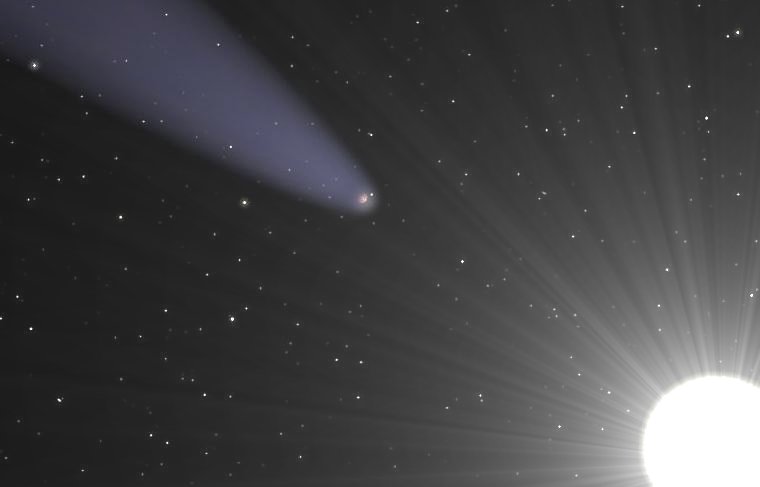 Image from Steve Bowers | |
| Osiris, a 'comet' world, losing its atmosphere in a steady stream over billions of years. | |
Example Osiris
Related Articles
Appears in Topics
Development Notes
Text by John M. Dollan
Initially published on 31 December 2007.
Initially published on 31 December 2007.






