
BY LETTER
Diwali

Galactography > Regions of Space > Inner Sphere
Galactography > Systems and Worlds > Systems & Worlds C - D
Galactography > Systems and Worlds > Systems & Worlds C - D
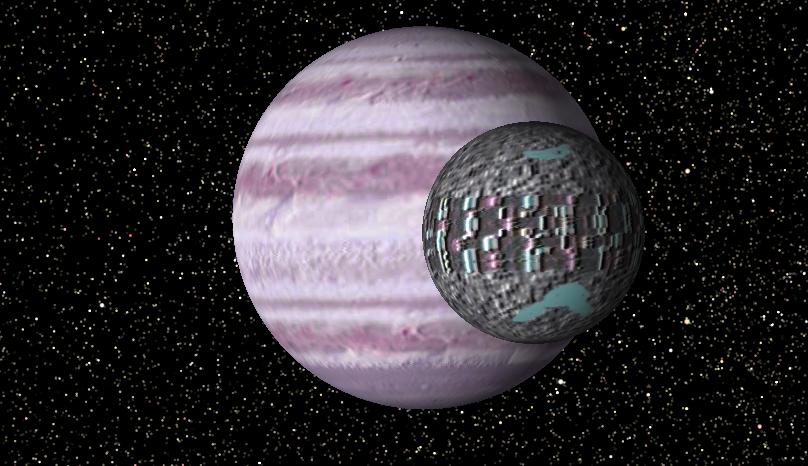 Image from Steve Bowers |
Diwali (Eta Cassiopeiae AbI) | |
| System | Diwali |
|---|---|
| Primary: | Eta Cassiopeiae A - also known as Achird |
| Stellar Type: | G0V |
| Companion: | Eta Cass B K7 orange dwarf 35-106 AU separation The Terragen Federation has established four city-state baseline colonies on planetoids around Eta Cass B |
| Region: | Inner Sphere Independent World |
| Planets: | Despite the similarity with Sol, Achird was not a good target for early colonisation efforts, because of the small jovian with an eccentric orbit which prevented any planets or moons forming in the the habitable zone Achird b eccentric jovian 60,000 km diameter - eccentric orbit from 0.3 to 6.0 AU Moons- Diwali- freeze/thaw cycle rocky ice moon- Parental Vec Colony Tamili- freeze/thaw cycle ice moon- Parental Vec Colony Mattancheri- freeze/thaw cycle ice moon- Solar Dominion Colony Achird c jovian 250,000 km diameter - eccentric orbit 8AU to 13AU Moons Cleavage Plane- miranda subclass- Silicon Generation Vec Colony Malabah- ice moon- Solar Dominion Colony |
| Diwali Local Artificial Intelligence | AI overseer: 2Surya AI's ethos: 2Surya is a partial copy of the original Keralan AI from the Solar System Amat Farm Belt. The south Indian ethnic habitat of Surya established in AT 411 on one of the rare class of Solar inframercurial asteroids (vulcanian subclass) had survived on volatiles from comets during the dark age and had restarted the amat laser farms in 861, allowing it to repel the aggressive intent of several Martian and Trojan gunships. This surfeit of available energy allowed the Keralans to launch a long planned mission to Eta Cassiopeiae. |
| Polity | Name: Diwali Symbol: Wheel of shimmering lights Affiliation: Independent Inner Sphere Colonized: 1037 Unmanned Seedship Dyaushpitr (launched 943) with a cargo of frozen Human zygotes and Parental vecs, male and female role-model characterbots that the Keralans and Surya had designed to be good parents. (robotic parents for the children who would be born into the new colony). These robot parents were generally known as Parental vecs. |
| Psyche, Art, Culture | History: The metal poor A star had one jovian planet, Achird b, in an eccentric orbit, with several moons and harmonic asteroids exposed to large periodic temperature ranges. The Parental vecs established a base on a small moon with an atmosphere that froze and fell as snow then sublimed with every orbit of the primary by Achird b. The Parental vecs did not consider conditions suitable for human colonisation in the short term, and instead built an synthetic human colony filled with copies of themselves, and new individuals which they designed. In 1605 a First Federation expedition arrived, and found a flourishing synthetic human civilisation on this inhospitable world, which the Parentals called Diwali. The Parentals were living in undomed cities with constantly changing ambient temperatures; although they had human form, they were tolerant of a wide range of temperatures. They still retained the human zygote material in biostasis, and this material was finally utilised at Fons Luminis, later the Solar Dominion capital world, where the children were at last born. The Parental Vec colony of Diwali never joined the Silicon Generation or Metasoft, and have created a synthetic human culture with echoes of south Indian culture to this day, and Solar Dominion and Generation habitats are also established in Achird orbit, with a cosmopolitan mixed population of vecs, parentals and posthumans. Metapsychology: New individuals among the Parental Vecs are constructed by mind-parents from extracted and cross fertilised character traits, some of which can be traced backwards to the original Solar System Grand Parentals. Other character traits which have arisen in the mind-parent as a response to contingent events in real life, and chosen by the mind-parents of the baby Parental. Each vec has an artificial childhood, to stimulate the ancient programming of the vecs. Metaethics: The Parentals have a strong urge to care for and protect Human Baselines and individuals of similar appearance, but this not as strong as in many other vec societies with slaved aioid imperatives. After the failure of the Achird Vecs to activate their human Zygotes, a second wave of Parental vecs were sent to Beta Cassiopeiae, with disastrous results (see the Children of Caph). Religion/Ideology: The Vecs have a deep-grained attachment to Hinduist worship, and are also followers of the mutated communism prevalent in Kerala, South India, just before the Technocalypse. Expiationism has become an influential philosophy, born out of the neo-Jainist movements of the 35th century. Solarism found on the many Dominion habitats and on Mattancheri and Malabah. |
| Culture and Art: | Language: Anglish, Hindi spacer dialect, Shamash dialect |
| Territory and Population | Population: Parental Drones -3 Billion (Diwali and Tamili) Near Baselines and augmented humans- Solar Dominion habitats and moons, and new cosmopolitan insulated cities on all worlds- 2 billion 3 Billion virches in Dominion cybercosm node near Achird A Powerfarm cap. Silicon Generation vecs - Cleavage Plane and vacuum habitats- 600 million Immigration: 10 million vecs per annum from Generation systems 20 million near baselines from Dominion and Terragen federation worlds p.a. 15 million Parental vecs p.a. to Perseus Expansion Direction, 10 Million Silicon Generation vecs to Perseus expansion direction, 50 million nearbaselines to all areas. |
| Government and Administration | Government Type Diwali- Parental Vec Aioid Family Clans National Holidays: Diwali- Spring Debacle, Summer Sublimation, Fall First-Snow Constitution: Diwali-Accords with Eden Declaration of Sentient Rights, signatory to Perseus Defence Association Mattancheri and Malabah. -AIocracy- rule of the Sun Emperor Legal System: Diwali - Informal slaving -- Parentals are asked to obey their mind-parents, and so on to the Original Grandparentals and 2Surya emself, however avoiding loss of free will wherever possible. |
| Economics, Local Infrastructure | Currency: Petabyte credit, Solar Credit, erg, angular spin credit Major Industries: Fractional fluid distillation, vec radiation shields, biont/aioid compatible media entertainments, biont/aioid compatible habitat design and construction, biont/aioid compatible blue goo defences Angelnetting: 2Surya has internal angelnet cliology incorporated into all baby Parentals, which may be removed later if the vec wishes. Other worlds and habitats- surveillance AI responsible to their parent empires Major Orbitals: 150 Dominion Bernal Spheres and O'Neill Habitats including Shabti and Jahangir 60 Generation vacuum habitats including Gneiss Place and Pahoehoe. |
| Travel | Stargates: The Parents of Invention - to Aksijaha |
| Spaceports: | Diwali - Pondicherry Pontoon, Dominion - 2/3 Harmonic Trojans Port Authority Hazard Rating: 0.0 -assuming full environmental precautions taken N.B. only the Parental hotels, Dominion worlds and habitats are baseline compatible Visa Restrictions: Open Access except for Metasoft Vecs and Emple-dok-cetics (invitation only) Environmental Requirements: Be prepared for Hard Vacuum, Extremes of Temperature and possibility of flash flooding/freezing except in Dominion territory or Parental Icebreaker Hotels Sites of Interest: Achird b Snowbow Storm Atmospheric Hotel Complex- experience the hedonistic hospitality of the Parentals Diwali Grandparental Palace at Coromandel |
Related Articles
Appears in Topics
Development Notes
Text by Steve Bowers
Initially published on 31 July 2002.
Initially published on 31 July 2002.






