Share
Jovian
Eujovians
Image from Steve Bowers

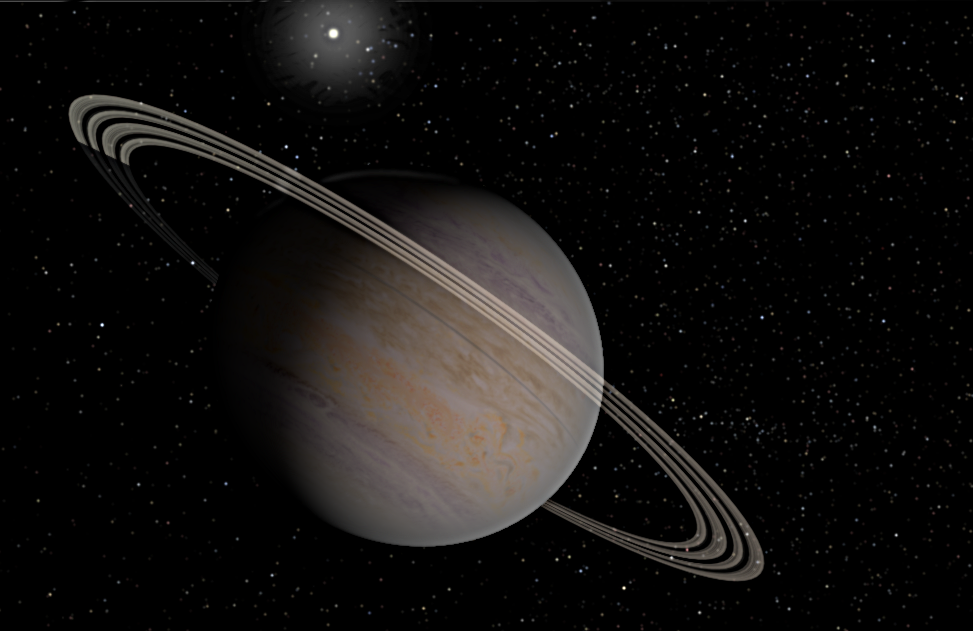
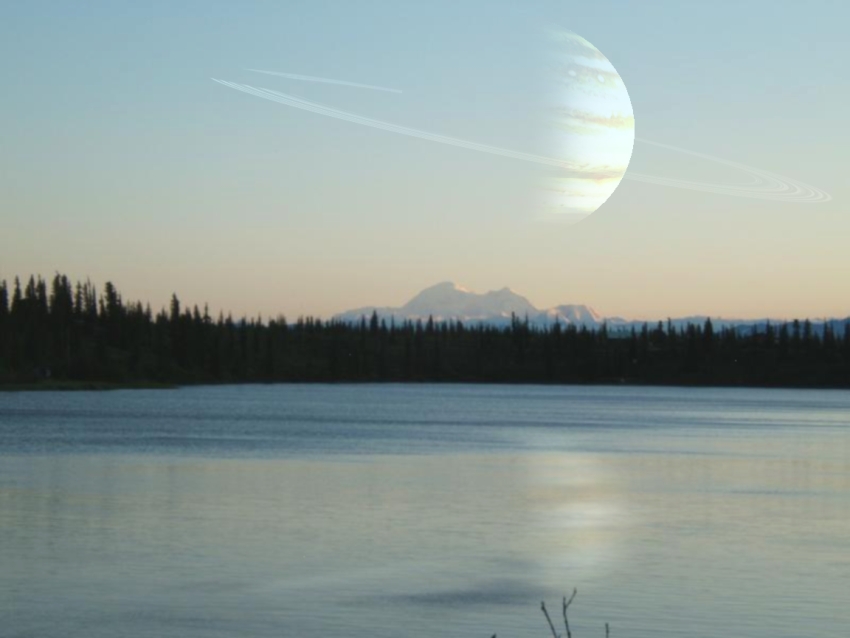
Jovians, or gas giants, are planets mainly composed of nebular gases: hydrogen and helium accreted from the protoplanetary disc. They are the most massive and largest of all types of planets. Although jovian planets can be found everywhere from very close to their host stars to detached orbits (or even unbounded), they are most common near the water frost line.

Jovian planets are often accompanied by an extensive system of satellites and rings. These entourages are often likened to planetary systems, and are highly sought-after by Terragens.

Table of Contents

1. Formation and dynamics
1.1 Formation
1.2 Location
2. Characteristics
2.1 Mass
2.2 Radius
2.3 Rotation and oblateness
2.4 Satellite and ring system
2.5 Appearance
2.6 Biosphere

Formation and dynamics

Formation

Jovians form from a process known as core accretion: a massive core of rock and ice rapidly grows until it reaches a critical mass on the order of 3E25 to 6E25 kg, or 5-10 Earth masses, where it can accrete gases within the protoplanetary disc (mostly hydrogen and helium). Gas accretion is initially delayed by the thermal pressure from the very hot core. As the core cools, the reduced thermal pressure allows the gas to accrete, causing the planet to rapidly grow into a jovian.

As the gas within the protoplanetary disc generally dissipates within a few million years, the formation of jovians is a rapid process which must conclude within that timeframe. This means jovians most often form in certain regions with high densities of solid materials, such as the water ice line.

A forming jovian is often accompanied by a circumplanetary disc, within which regular satellites, whose orbits are aligned with the planet's equatorial plane, can form.

Location

Jovians are most common around stars between 1 and 2 solar masses, around which the occurrences reach approximately 20-30%, and become increasingly rare around less massive stars. They strongly preferentially form around high metallicity stars, whose protoplanetary disc contains more materials to rapidly assemble jovian cores before the gas disc dissipates.

Jovians most frequently form just beyond the water ice line, but they are able to form further out to tens of astronomical units. Beyond roughly 100 au, disc fragmentation begins to dominate, forming sub-brown dwarfs instead. In mid-separation binary star systems, they may also form near the circumstellar disc truncation radius.

Many systems contain only 1-2 jovians, but multiple massive jovians can form in some systems; such systems are prone to dynamical instability, which can eject some jovians and send others into eccentric, inclined orbits, to the detriment of other planets in the system.

A small number of jovian planets migrated from their formation location to orbits interior to the water ice line, usually becoming warm or hot jovians. Such planets may migrate inwards by interactions with the gas disc or planetesimals, which allow them to gradually migrate inwards, sometimes alongside other smaller planets, or by dynamical scattering or von Zeipel-Lidov-Kozai mechanism placing the planet in an eccentric orbit (and scattering away other planets), possibly followed by tidal circularization. These processes can place jovians in a variety of orbital distances, eccentricities, and inclinations from the host star's rotation plane.

Characteristics

Mass

Jovians generally have masses ranging from several tens of Earth masses, where the mass of the accreted hydrogen-helium envelope equals that of the core of heavier elements, to over ten Jupiter masses. The large masses these planets have are the consequence of their formation requirement, where a core within a protoplanetary disc needs to be sufficiently massive to attract gases, as well as the need for a deep gravity well to prevent hydrogen and helium, two of the lightest gases, from escaping.

Often, jovian planets are divided into mass types. The three types commonly used are:

Subjovian: <5.7E26 kg (<0.3 Jupiter masses). Planets in this type rapidly grow with increasing mass. Some subjovians with lower masses do not have a metallic hydrogen layer in their interiors.

Midjovian (or sometimes just Jovian): 5.7E26 - 5.7E27 kg (0.3 - 3 Jupiter masses). The radius of midjovians increases slightly with increasing mass, reaching a maximum near the upper boundary of this type.

Superjovian: >5.7E27 kg (>3 Jupiter masses). The radius of superjovians decreases slightly with increasing mass, a trend which can also be seen in brown dwarfs and white dwarfs.

Radius

Behemoth Hat-p-1b
Image from Steve Bowers
Behemoth, a hot Jovian planet, compared in size to Jupiter.
At lower masses, the radius of jovian planets rapidly increases with mass. The rate slows past approximately 0.3 Jupiter masses, as additional mass accreted compresses the interior more strongly. Jovian planets eventually reach a maximum radius of approximately 86000 km at around 3 Jupiter masses; above this mass, the planet begins to slowly shrink with increasing mass.

In practice, jovian planets can be larger than this theoretical limit due to heat. Young, hot jovian planets start out significantly larger than their older counterparts; the cooling of the surface over time causes them to shrink, according to the Kelvin—Helmholtz mechanism. Additionally, jovian planets orbiting close to their parent star can also have their radii inflated due to heat, effectively increasing their sizes. These hot Jupiters can have radii as large as approximately 160000 km, or 2.2 Jupiter radii.

Rotation and oblateness

Many jovian planets, especially those located far from any other similarly massive body, retain fast rotation from their formation. This spin rate is generally a significant fraction of their breakup spin rate. This high spin rate causes many jovians to become noticeably flattened (oblated). The degree of oblateness is dependent on both the speed of rotation and the surface gravity, so that the most oblate jovians are those with relatively low gravity and fast rotation.

Satellite and ring system

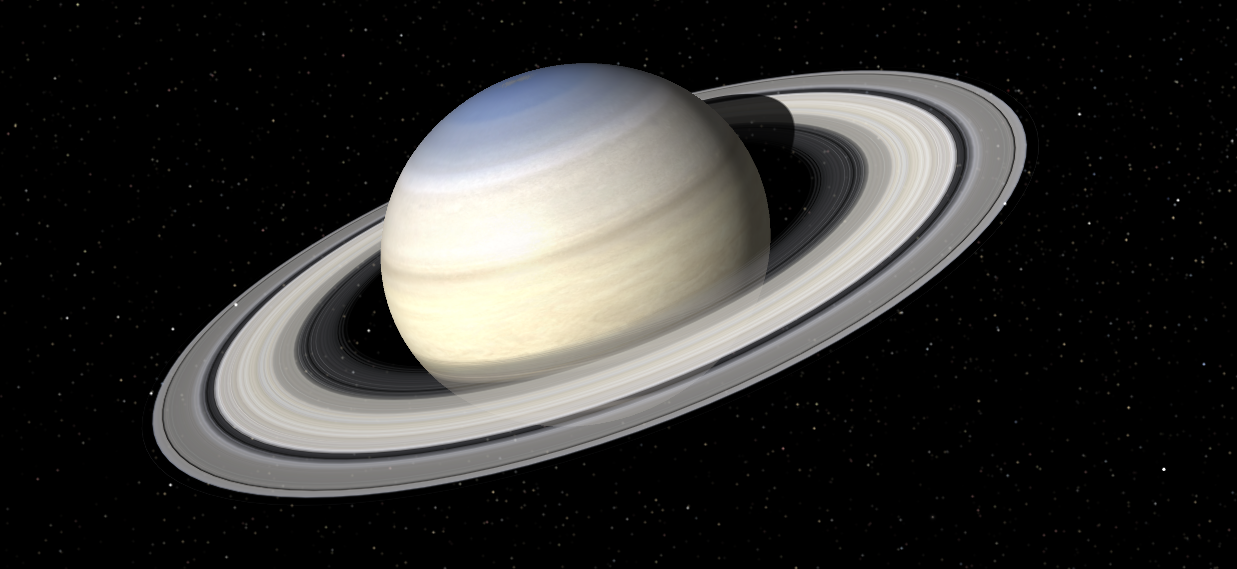
Saturn
Image from Steve Bowers
Saturn in the Solsys system
Jovians generally form with a number of satellites. These regular moons, which come in all sizes, from asteroidal bodies to planetary bodies, are generally found in orbits well-aligned with the parent planet's equator, the result of their formation in the circumplanetary disc. Additionally, jovians can capture passing objects, turning them into irregular moons. These are often found in distant, inclined, strongly-perturbed and ever-evolving orbits. These satellites often collide with each other, producing families of smaller fragments in similar orbits, a behaviour reminiscent of asteroid belts around stars.

Gravitational interactions between large moons in mean-motion resonances, combined with tidal circularization converting their orbital eccentricities into heat, produce intense heating on some of the moons orbiting jovian planets. These may result in endogenous geological activities on moons that would otherwise be too small or cool to exhibit them.

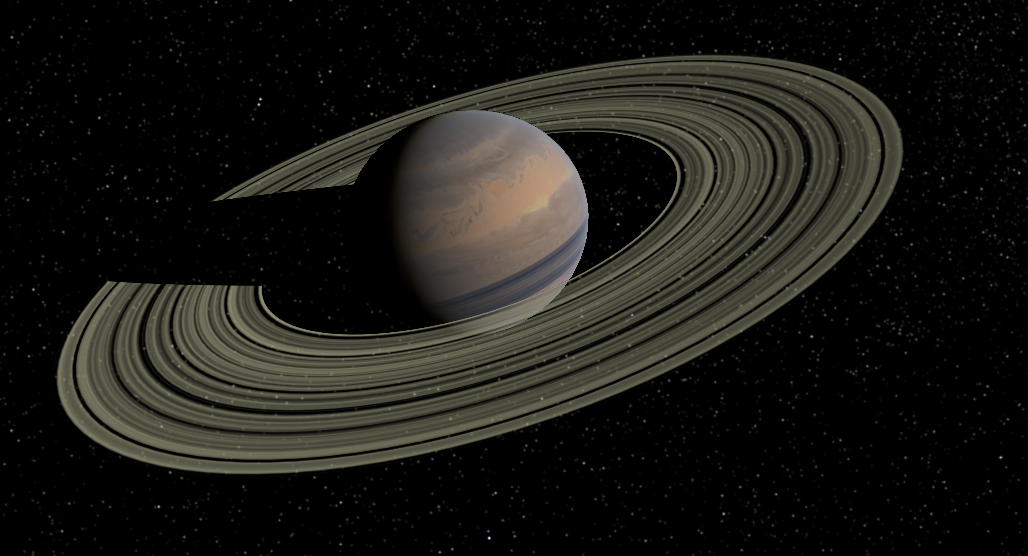
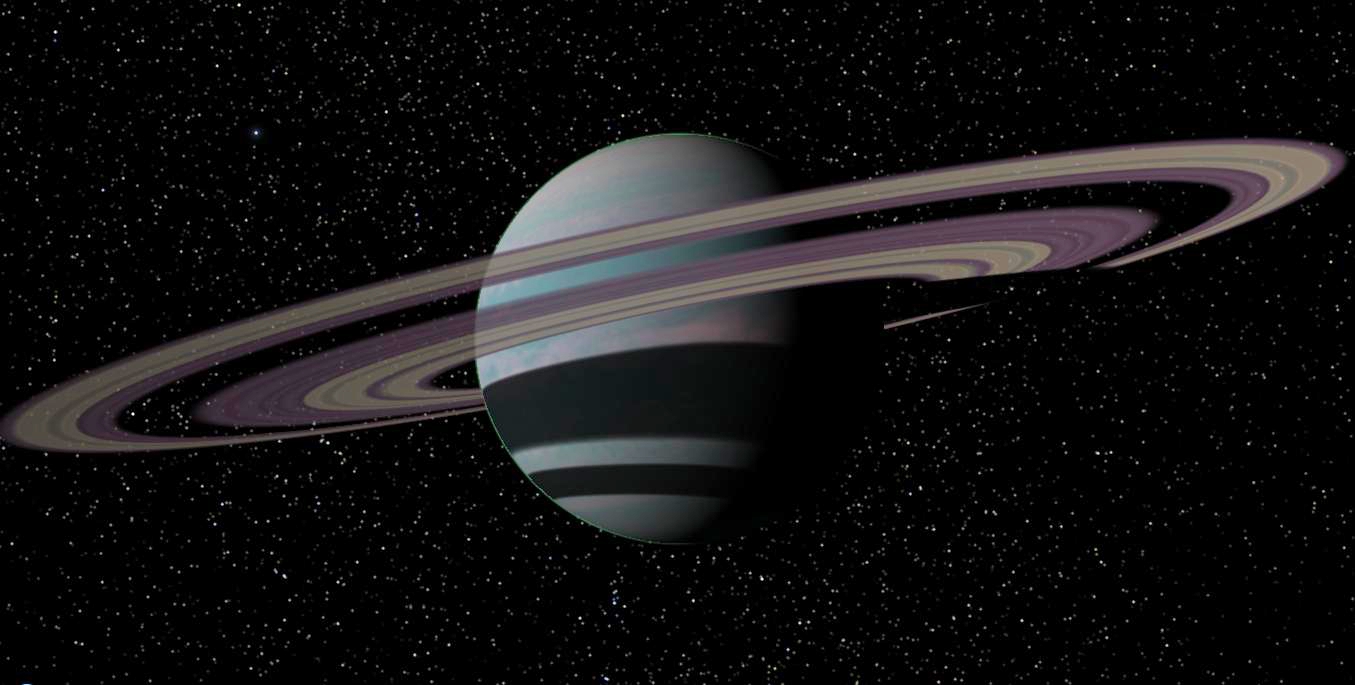
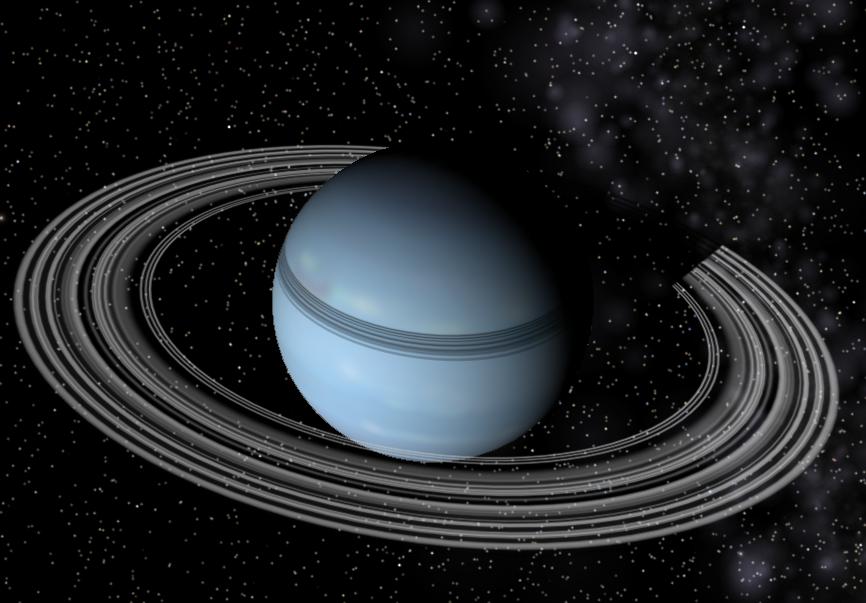
Many jovians also possess systems of rings. These rings may be dense and highly visible, or sparse and dim. These rings interact with the planet and its moons; satellites can carve gaps in the ring through resonances or shepherd rings, and gravitational interactions with the planet's oscillations can produce spiral waves within rings.

Some jovians have experienced strong gravitational interactions with other massive bodies; such disruptions can dramatically alter, if not outright destroy, satellites and rings around them. Additionally, a jovian which has migrated close to the star would see their Hill sphere shrunk and their rotation rates slowed, possibly becoming tidally-locked. These can also result in loss of satellites and rings.

Appearance

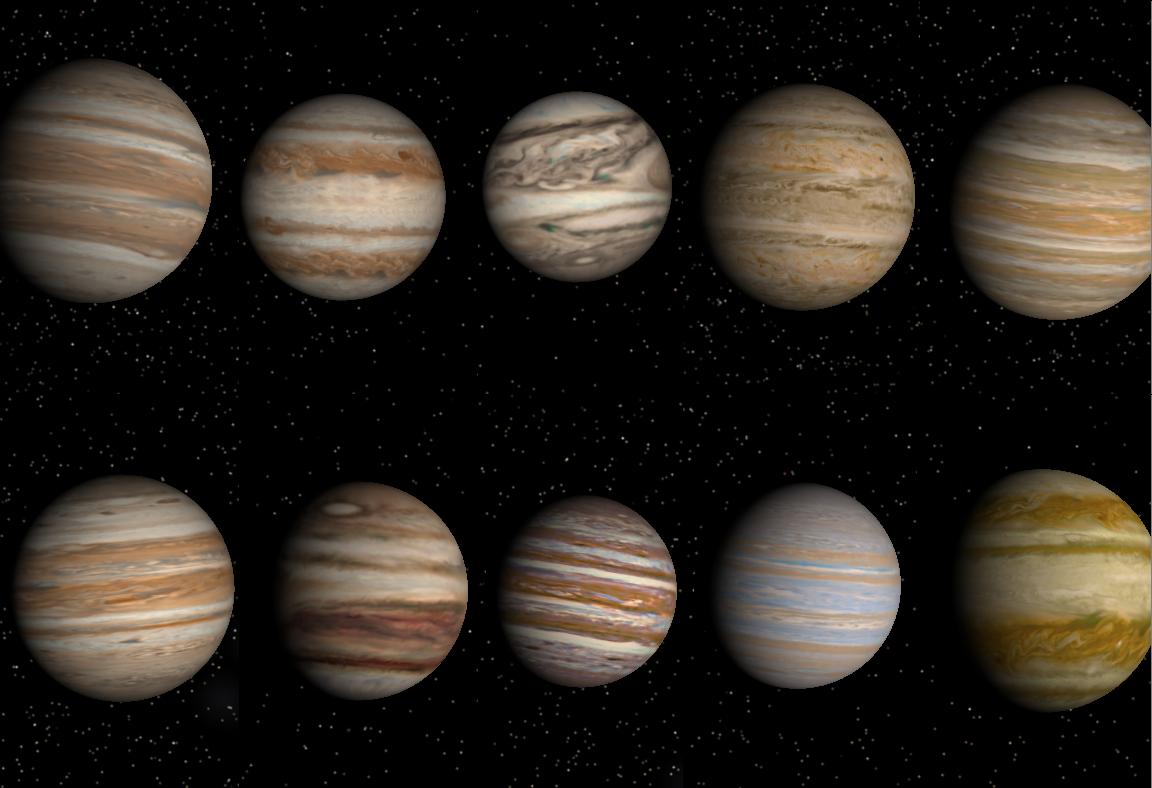
Jovian planets, like Neptunian planets, do not have a visible surface. Their overall appearances are instead described by a number of effects in the atmosphere: Rayleigh scattering, absorption, clouds, and photochemical hazes. The exact details correlate strongly with the temperature of the atmosphere. Hence, jovians are frequently classified by their temperature or aerosol types.

In absence of other effects, Rayleigh scattering produces a white appearance. This is because even though it is more efficient at scattering shorter wavelength photons, a jovian's atmosphere is deep enough that even longer wavelength photons can largely be scattered back. However, most jovian planets do possess other effects which can alter their appearances from space.

Various gas species in a jovian planet's atmosphere can absorb photons at specific wavelengths or ranges of wavelengths, producing various shades of colours depending on the exact species and concentrations. Common species which strongly absorb in visible light include methane, water, and alkali metals.

Jovians generally form multiple layers of clouds of various chemical species at different depths in the atmosphere. The main cloud decks can reach as high as the tropopause at around 0.1 bar, while thin, wispy clouds can reach further up in the atmosphere. Only the uppermost cloud layers are visible, as deeper layers are obscured by atmospheric scattering if not upper clouds.

Additionally, photochemical hazes may form in abundance on planets receiving high energy photons (usually from their host star). Hazes can form at much higher altitudes than cloud decks, and if sufficiently thick, can even completely obscure underlying clouds. Hazes can be cleared out either by the lack of active replenishment (usually by the lack of sunlight in shaded regions) or via storms.

Biosphere

Menexenos
Image from Steve Bowers
Menexenos in the Socrates 471 system
Jovian planets possessing biospheres are relatively rare, as many of the necessary elements for life are generally diluted and only found in low quantities. Such life may originate on these worlds, or transfer from other worlds (usually their own moons).

Examples of jovian biospheres include Big Bob and Lontis, where life is found in their upper atmospheres, and Menexenos, where life inhabits the metallic hydrogen layer.

Canaria ::
Canaria in the Guanche system
Hibou
Image from Steve Bowers
Hibou in the Calyx system
Franklin
Image from Steve Bowers
Franklin in the Beta Virginis system
 
Related Articles
 
Appears in Topics
 
Development Notes
Text by AstroChara
Expanded from original article by M. Alan Kazlev, with additional material by Steve Bowers (2018)
Initially published on 09 December 2001.

Additional material by Steve Bowers (2018)

2025-10-14: Overhauled by AstroChara
- Rewriting and expanding the existing content: "Oblateness", "Size", "Rings".
- Merging content from "Jovian Class" article as part of merger: "Biospheres".
- Adding more sections: "Mass", "Appearance", and expanding oblateness into "Rotation and oblateness".

2025-10-22: Updated by AstroChara
- Added "Formation and Dynamics" section.
- Added Table of Contents
 
Additional Information
Maximum radius of cold jovians from https://arxiv.org/abs/2509.07048

Maximum radius of tidally-heated jovians from https://ui.adsabs.harvard.edu/abs/2022MNRAS.511.3133H/abstract
 
 
>