Share
Oceanus Ultimata

Artificial ring-shaped ocean of xenosophont origin, surrounding the star Beyniou

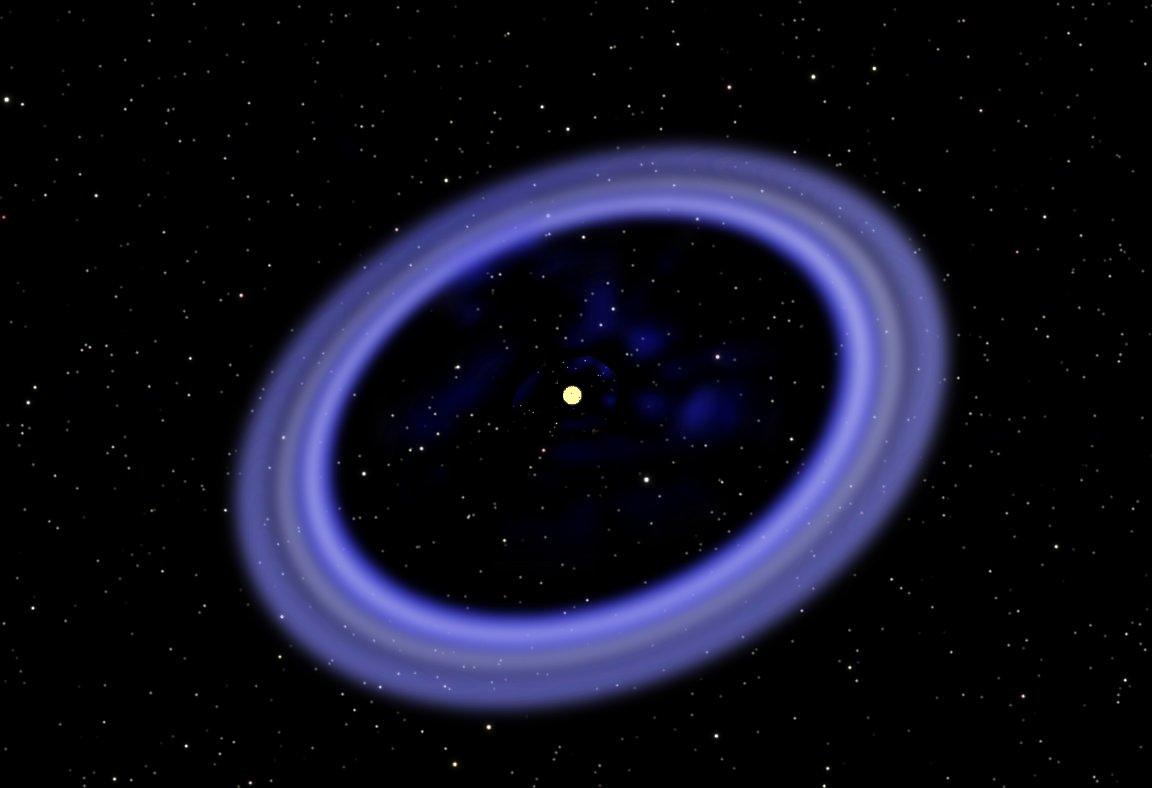
Oceanus Ultimata
Image from Steve Bowers
This mysterious ocean of water droplets forms a ring, which is illuminated by the star and an array of statite reflectors.

Data Panel - Oceanus Ultimata

StarBeyniou, YTS 998-540-44-8-1
TypeG2V
Luminosity1.05 x Sol
Distance from Sol7122 ly
ConstellationMusca

The unusual structure that would come to be called Oceanus Ultimata was first discovered in the Federation Era. While the star Beyniou had been catalogued before the Sundering, and evidence of a debris ring had been noted, it was not until 1198 AT that astronomers in Solsys determined that the ring was brighter than could be explained by illumination by Beyniou alone and consisted almost entirely of variously sized bodies of liquid water — a seeming impossibility, since water would either evaporate, sublime or freeze in a naturally occurring ring system of this kind. One hypothesis of the time suggested that the ring was artificially maintained in some way to prevent volatile loss, but even using the largest optical interferometers then available no direct evidence of this could be detected, nor could any habitats, spacecraft or other technology.

At a distance of more than 7000 light-years, there was no immediate prospect of solving the mystery that Beyniou represented. Nevertheless many plans were made for closer future examination and eventual direct exploration. The long, relatively slow expansion of the Terragen Sphere (and the later expansion of the Wormhole Nexus) would eventually reach this location, but it would be many thousands of years before this occurred. Infused with the optimism of the early Federation (perhaps helped along by both ongoing advancements in longevity technology and the more recent spread of non-destructive uploading), such an extended duration seemed less of an absolute obstacle and more an extended interregnum to be passed through.

Over the next few millennia, telescopic observations improved considerably, especially with the construction of the Argus Array and its related networks. A number of shepherd moons were discovered orbiting within the ring system as well as clouds of indistinct, but large scale, particles apparently occupying a number of polar orbits around Beyniou, although their exact nature remained a mystery. The large bodies of water in the ring were observed to merge and split up, and smaller moving objects of various sizes could be seen within the liquid, although it was not clear if these were biological organisms or artificial entities. Many theories concerning this behaviour were formulated, but they could not be confirmed without a closer examination.

When the Carina xenowormhole was discovered in 6601 AT, the opportunity arose to vastly accelerate the timetable for exploration of the Beyniou system. Although the ring was more than two thousand light-years from the far end of the Carina wormhole and located in the Musca radial sector, an exploration mission using the wormhole could reach it far more rapidly than one traveling via normal space. The 80Star Investigation Authority, a Carina Rush exploration faction led by a rather pioneer-mind S4 entity, took the opportunity to dedicate a small fleet of craft to such a mission, which would arrive in 9462 AT.

The findings of the expedition were transmitted back to the Known Net via a comm-gauge wormhole brought along for the purpose, and included much new information.


Oceanus Ultimata Droplets closeup
Image from Steve Bowers
A close-up view of the water droplets in the Oceanus Ultimata megastructure.

Overview

The Oceanus ring system is an artificial structure consisting almost entirely of liquid water divided into individual drops, blobs, globes and elongated bodies, each encased in a technological membrane and orbiting the star at about the same density as Saturn's rings. The innermost sections of the ring orbit at about 80 million kilometers from the star while the outer region ends at about 200 million kilometers distance; average ring thickness is about 32 kilometers.

While the inner third of the Ultimata ring complex receives the majority of its illumination directly from Beyniou, the middle and outer regions mainly rely on light provided by arrays of statite reflectors positioned some 3 AU above the North and South solar poles. These reflectors had been a mystery to earlier astronomers, who could not resolve them individually and thought they were in polar orbits, but their true nature was quickly determined once the first expedition reached the system.

Individual components of the ring range in size from a few millimeters up to about 10 kilometers across (although short-lived components as large as 15 kilometers across have been reported). Regardless of size, each is contained by a xeno-tech smart-matter membrane that protects the contents from the space environment. Individual membranes prevent the liquid interior from boiling away into the vacuum, can vary their reflectivity and insulative properties to regulate the temperature of the water and generate a magnetic field that protects against solar and cosmic radiation. Membranes also possess a limited propulsive capability using a combination of light pressure, <{A54ee3dd3291c0,magnetic/plasma sailing}> and the peristaltic expulsion of small amounts of water (when this last method is used, the resulting 'exhaust' is virtually always directed at other components of the ring which absorb it through their membranes). Over time, the combined efforts of different membranes causes the ring components to 'churn', gradually changing their orbits and orbital inclinations and sometimes even colliding with each other. As a result, a warm tropical region may migrate out to the frigid edge of the system or ecosystems that have been separated by millions of kilometers and tens of millions of years may suddenly come into contact with each other. The membranes regulate these changes and can cause individual components to either merge together, split apart or ricochet off each other, resulting in a slow but constant process of climatic shift and intermixing of aquatic environments, driving evolutionary change and adaptation.

Structurally, each membrane consists of linked microscale units that are functionally similar to Terragen airwall mesobots, although their design specifics (e.g., number of limbs, central body shape, processing core design, etc.) are notably different. The majority of subunits are specialized according to type, but a minority (colloquially termed 'queens') are capable of creating new membrane units, repair units and even additional queens as required. The membrane subunits interlock to form a thin, but dense, utility fog that is able to maintain the internal environment while also acting as a solar collector to provide energy for various maintenance functions such as temperature control, magnetic shield generation, active water circulation, and propulsion. As a membrane wears out (as a result of radiation damage, malfunction, etc.) it is reabsorbed and replaced with new mesobot units manufactured inside the droplet. Individual membranes seem to communicate with each other using modulated light and radio to coordinate their activity with nearby components and the ring as a whole. In combination with the complex array of shepherd moons this system permits the ring to maintain its structure. Despite the huge amount of processing power this implies, there is no evidence of any level of self-aware intellect involved. The whole system seems to rely on non-sophont automation running on a distributed processing network of the queen units built into the membrane and floating in the water itself. If there is a higher level of intelligence here, it is not communicating the fact. The age of the ring complex is uncertain, since it is self-repairing.

Shepherd Moons and Statites

Dozens of shepherd moons orbit within the Oceanus Ultimata ring, ranging in size from several hundred to over 1000 kilometers across. They act to both stabilize the ring complex and provide raw materials for the creation and recycling of both ring bubbles and statite illuminators. Each moon is home to a moderately complex mechosystem of vacuum-adapted biocybernetic organisms that are superficially similar to several species of Terragen vac-life, but with a number of differences at the cellular and programmatic level. Individual mechosystems absorb solar energy and raw materials from their home moon and use it to grow 'buds' that are then launched from the surface, where they deploy a reflective membrane for both solar sail propulsion and optical navigation. The majority of buds propel themselves to one of the polar statite arrays (a voyage that can take years) and reconfigure themselves to join their fellow reflectors, replacing those that are lost to senescence or the occasional accident. The remaining minority adopt interception courses that result in a comparatively gentle impact with one or another of the ring water bubbles, where they are rapidly absorbed by the local membrane and broken down into raw materials used to renew the local structure and ecosystem.

Each statite begins its lifecycle as a bud from a parent plant growing on one of the shepherd moons. Over a period of several years, the parent plant accumulates and stores solar energy in dense muscle-like tissues in coiled tendril-like 'branches' radiating from a central core. At the same time, the bud absorbs a mixture of elements and compounds, including a supply of volatiles, some of which will be used for reaction mass. When a bud is 'ripe', the parent plant will cause its branch to rapidly uncoil, releasing the bud at the point of maximum extension and flinging it away from the local moon at escape velocity. Once sufficiently far from its home moon, the bud will deploy its solar sail and use light-pressure to begin the journey to its destination.

Statites may spend centuries in one of the polar arrays, but do have a finite lifespan. Toward the end of its life, a statite will reconfigure back to a solar sail form and break away from its home array, gradually deorbiting to an impact with either a shepherd moon or a portion of the ring system, where its remaining structure is broken down and recycled for further use.

Oceanus Ultimata Species
Image from Steve Bowers
A small selection of the alien species observed in this vast biosphere.

Lifeforms of Oceanus Ultimata

The multitude of aquatic environments that make up Oceanus Ultimata are home to a wide array of lifeforms, each of which is adapted to microgravity and accustomed to migrating from location to location whenever the droplets merge or break apart. Most organisms are radially symmetric, and have no preferred direction of movement. Radial organisms include the Tanglestar and Actinopod, which have multiple arms and feeding organs. However, some local predators have definite front and back ends, with mouths or jaws at or near the front and waste disposal orifices near the rear. Examples of these include the Tasslefish and Gripperfish, which have cylindrical symmetry. More unusual are the Chiralworms, which have either left- or right- handed helical morphology. One of the largest organisms is the Trilowhale (30 m), which usually consists of three separate bodies; these are capable of independent survival, but can join together on a temporary or long-term basis according to trophic levels in their local water mass.

Reefs

The larger Oceanus environments are home to 'Reefs' - masses of coral-like organisms which in turn form homes for a wide variety of native lifeforms. It is believed that the minerals forming the shells of the Reefs originally began as small to medium-sized asteroids placed inside the larger droplets and used as anchors for various sessile or slow-moving lifeforms. However, over time these have been consumed and converted into the Reefs themselves, which now persist through a combination of efficient recycling and occasional mass infusions from the shepherd moons or senescent statites. Reef components are able to break apart or join together along with their home environment, although below a certain level of division, they abandon their collective behavior and either enter hibernation, sporulate, or change to a more mobile mode of behavior. Reefs also limit their growth based on the size of their environment, presumably to avoid exhausting the local environment of their component raw materials.

Current Status

The 80Star Investigation Authority has recently installed a stargate linking Beyniou to the Nexus, using mass-energy extracted from a nearby red dwarf. This has opened the system up to a wider range of investigation, including representatives from the NoCoZo, MPA, Zoeific Biopolity, and even the Chthonids, the nearest xenosophont species.

The arrival of a transit class wormhole has also exacerbated a multi-decade, multi-party debate between the 80Star Investigation Authority, which claims ownership, and several other competing Carina Rush interests. Preservationists wish to protect the system, researchers want to study it, and various local water-adapted clades have expressed an interest in establishing colonies (although this last is considered highly unlikely to occur).

Various commentators have also noted the possibility that some Caretaker God might one day step in and appropriate the system. Whilst Caretaker Gods are notoriously erratic in their views of what is natural and should be protected, Oceanus Ultimata and its vast and unique biota would seem to be an excellent candidate for a Caretaker God protectorate.

To date, no sophont or pre-sophont beings have been found in the Oceanus system. Nor has any evidence of the builders, beyond the ring itself. But the ring is huge and exploration has barely begun. New discoveries are happening constantly and the latest revelation might radically change the dynamics of the situation at any time.
 
Related Articles
  • Carina-Vela Outer Volumes - Text by M. Alan Kazlev
    Large region of space in the outer volumes, not affiliated with any of the main empires. The Andian Mission today remains a highly regarded support organization here.
 
Appears in Topics
 
Development Notes
Text by Todd Drashner, with some comments by M. Alan Kazlev and Anders Sandberg
2025 update contributors - Steve Bowers, Borklord, Liam Jones, AstroChara
Initially published on 05 December 2001.

article expanded in 2008-2010
article updated/expanded 12-06-2025
 
 
>