
BY LETTER
Boostbeam

Technology > Application > Transportation > Interplanetary Transport
Technology > Application > Transportation > Interstellar Transport
Technology > Application > Transportation > Propulsion Technology
Technology > Application > Transportation > Ships
Technology > Application > Transportation > Interstellar Transport
Technology > Application > Transportation > Propulsion Technology
Technology > Application > Transportation > Ships
Mass-beam based system used to accelerate or decelerate spacecraft without the use of onboard reaction mass. | |
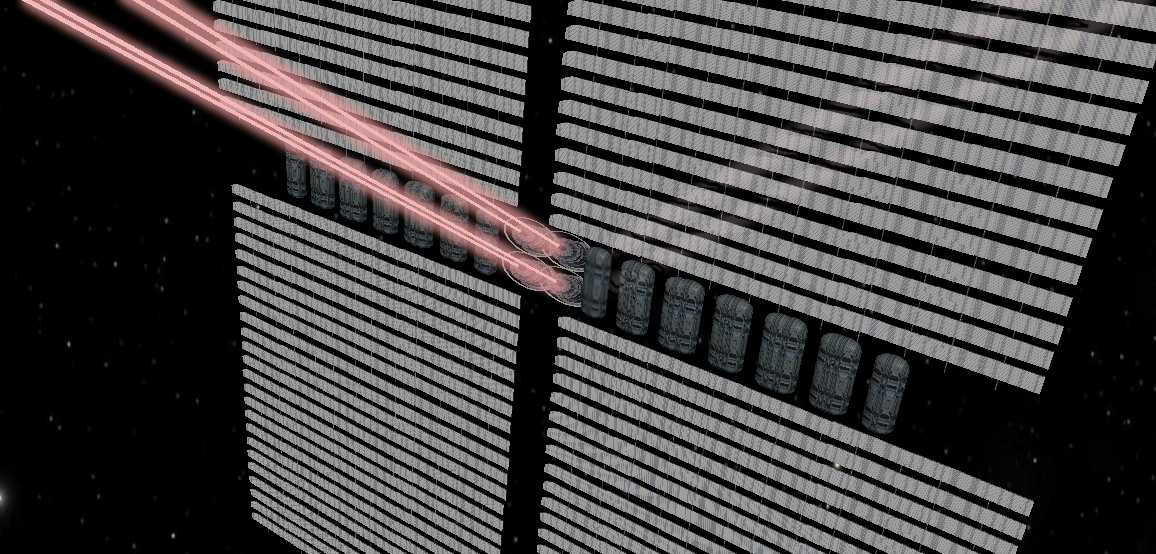 Image from Steve Bowers | |
| When the boostbeam first leaves the emitter station it is clearly visible, even in the vacuum of space, since the mass particles are radiating heat | |
Interplanetary boostbeams will typically accelerate a target vessel to no more than a few thousand kilometers per second, although some high-speed systems will employ continuous boost for the entire journey, using beam projectors at both the point of origin and destination to achieve maximum velocity and minimum travel time.
Interstellar beams generally boost their target vessel to no more than 5% of the speed of light after which the ship switches over to onboard propulsion, accelerating the rest of the way to its preferred cruise velocity. 5% of c is generally considered the most efficient level of performance since it is just above the speed at which ramscoop systems (found on most starships) become effective while also requiring only a fraction of the energy and infrastructure needed to generate and focus more powerful beams capable of boosting ships to higher velocities.
In the case of interstellar ram drives, the magnetic fields of the ramscoop are initially configured to act as a magnetic mirror, reflecting the mass-beam and accelerating the vessel up to a speed sufficient for the ramscoop to function, then reconfiguring to accelerate the interstellar medium and boost the ship up to full cruise velocity. Finally, when the ship is approaching its destination, the ramscoop is again reconfigured to act as a magnetic sail (also known as a rambrake), reacting against the interstellar medium and slowing the vessel down to interplanetary velocities at which point onboard fuel or a local boostbeam is used to bring the ship to a relative halt at its final destination. Since even non-ramscoop vessels are routinely equipped with rambrake technology for deceleration, boostbeams are commonly used for final braking maneuvers across the Civilized Galaxy.
Boostbeams are also commonly used across the Wormhole Nexus, boosting wormhole ferries to and from the local gateway, between the gates of the various relay and plexxi systems, and to accelerate vessels from the local Exit Station toward the wormhole mouth. At the midpoint of the journey, the mass-beam is turned off and the ship performs a turnover maneuver and decelerates to the wormhole throat using onboard reaction mass. After the ferry has transited the wormhole, it will use onboard fuel to travel outward until it has passed the Entrance Station transit grid and can switch to a boostbeam to propel it to the local system or the next wormhole.
The first primitive magbeams for propulsion entered service in 85 AT, in Earth orbit and on Luna. Each projector used a large solar array and superconducting storage rings to produce the 82MW of energy needed to accelerate a 10 tonne transport craft on a tenth-gravity continuous boost trip to or from the Moon. Magbeams were used routinely during the Interplanetary Age within the Solar System, and later were instrumental in accelerating the first interstellar probes and beamriders. However, shortly thereafter the Technocalypse put an end to virtually all technological advancement in the Solar System for several centuries.
The rise of the First Federation, and the subsequent reconnection with the Deeper Covenant, brought both beamriders and boostbeam technology into the wider interstellar civilization. Although the Federation had initially based its transport infrastructure on antimatter propulsion, mass-beam technology offered increases in efficiency that simply could not be ignored. Early systems were not sufficiently capable to replace amat propulsion entirely (particularly when rapid transit was desired) but eventually came to form both the backbone of most medium speed interplanetary transport systems and the basis for interstellar launch systems in most of the more heavily populated systems of the day.
Related Articles
Appears in Topics
Development Notes
Text by Todd Drashner
Initially published on 29 April 2013.
Initially published on 29 April 2013.






