
BY LETTER
Atomic Age

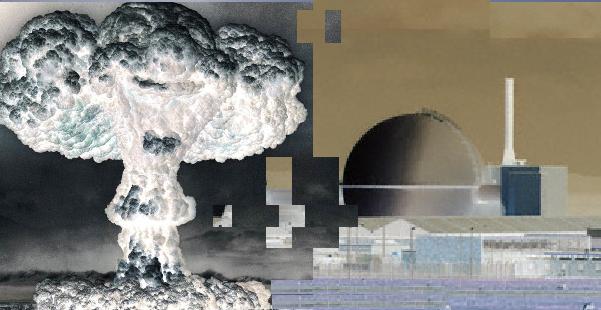 Image from Steve Bowers |
The period in Terragen Old Earth history initiated by the discovery of radiation and atomic structure, and later, by nuclear weapons and atomic energy as a military, political, and industrial factor. More or less equivalent to the the early and middle 1st century BT to early 1st century AT (20th century of Old Earth dating). The Atomic Age is sometimes considered a part of the Industrial Age and sometimes considered separately.
The Atomic Age was replaced by the Information Age (which is arbitrarily dated at the origination of the Terran World Wide Web) but nuclear weapons continued to remain a threat for many centuries to follow.
Isolated colonies which have regressed to low technology status sometimes enter an independent atomic age, deriving power from fissile elements in the planet's crust. On a few occasions the use of fissile elements has led to atomic warfare.
Articles
- Chandrasekhar, Subrahmanyan - Text by M. Alan Kazlev
Old Earth Indian-American astrophysicist, 59 BT - 26 AT (1910 -1995 c.e.), who studied stellar physics, evolution, and black holes. He realized that the fate of dying stars depended upon their mass, and above a certain point (1.4 times Sol mass, known as the "Chandrasekhar limit"), a star will undergo extreme collapse and not simply becomes a white dwarf. There are a number of asteroids, habitats, ships, one black hole, and several black hole observatories named in his honor. - Einstein, Albert - Text by M. Alan Kazlev
Old Earth late Industrial Age German/American physicist, 90-14 BT (1879-1955 c.e.) and popular su genome template. Formulated the Theories of Special and General Relativity. Einstein won the Nobel Prize in 48 BT (1921 c.e.) for explaining the photoelectric effect. - Gagarin, Yuri - Text by M. Alan Kazlev
Lived 35 BT to 1 BT (1934-1968 c.e./AD). Soviet cosmonaut and the first man to orbit the Earth. He piloted the Vostok 1 mission which launched April 12, 1961 and orbited the Earth. The flight lasted 108 minutes. Gagarin died years later in a plane crash. - Turing, Alan - Text by M. Alan Kazlev
Late Industrial/early Atomic Age British mathematician and computer theorist, 57 to 15 BT(1912 - 1954 c.e.); one of the fathers of artificial intelligence and computing.
Development Notes
Text by M. Alan Kazlev
Initially published on 04 October 2001.
Initially published on 04 October 2001.






