
BY LETTER
Toposophic Level and Brain Size

Technology > Application > Computronics
Sophonts > Transapients > First Toposophic - Basic Transapients
Sophonts > Modosophonts
Sophonts > Transapients > Second Toposophic - High Transapients
Science > Sophontology > Toposophy > Singularity Levels
Science > Sophontology > Toposophy > Toposophic Scales
Sophonts > Transapients > First Toposophic - Basic Transapients
Sophonts > Modosophonts
Sophonts > Transapients > Second Toposophic - High Transapients
Science > Sophontology > Toposophy > Singularity Levels
Science > Sophontology > Toposophy > Toposophic Scales
Processing Substrate Parameters, from Modosophont level to the Third Singularity |
 Image from Arik |
Terragen civilization is inhabited by a vast diversity of intelligent beings possessing myriad levels and types of mind. Ancestral humans of pre-Information Age Old Earth could be confident of being roughly equal in intelligence and capability to all of their peers, based simply on the fact of their shared humanity. A sophont in the modern era faces a much more complex set of considerations. This page details the most common and generally capable configurations of brains across the terragen sphere.
Intelligence in the modern galaxy may be based on organic or inorganic substrates. It may be naturally evolved, genetically engineered, or designed from the atoms up for a specific purpose or with specific abilities emplaced either by itself or its creator. It may be of any of seven toposophic levels (S0-S6) or may be of one S-level in most regards but with specific, engineered toposophic (or transavant) 'spikes' in particular areas of intelligence or ability. It may be concentrated (operating within a single processing node), distributed (operating across many processing nodes), virtual, or corporeal. Finally, it will almost certainly possess, or eventually possess, the experience and accumulated knowledge gained from centuries or millennia of contact with the titanic and ever-expanding mass of information that permeates and inter-connects the Civilized Galaxy.
In considering all the variables that may characterize a given intelligence within the known galaxy, the factors that are often taken into account are:
- What is the processing substrate of the entity concerned?
- What is the entity's toposophic level?
- What is the origin of the entity?
- If engineered or created, what was the S-level of the originating entity or entities?
What is the entity's processing substrate?
When considering a given sophont, the material that its brain is constructed from can often provide insight into the likely scope and range of capabilities the being may possess. Substrate type can often determine the size, speed, memory storage, waste heat output, and likely durability of a sophont's brain. In addition, certain substrates can only be created or used by entities at or above a certain toposophic level.What is the entity's toposophic level?
A being's toposophic level can have a very direct impact on the type and capability of its processing substrate. The majority of beings of a given S-level operate their minds on substrates that cannot be duplicated, or even fully comprehended, by sophonts of lower S-levels. At the same time, virtually all "naturally arising" sophonts of any toposophic level have originated using processing substrates that were far less capable than what the beings in question eventually develop for themselves.When considering a given sophont, the toposophic level of that sophont can often provide insight into the likely size and type of processing substrate that the sophont may employ as well as its likely range of capabilities.
What is the entity's origin?
Sophonts may either evolve naturally or be created by other beings of equal or greater toposophic level. If a sophont has developed naturally or by its own efforts, or been engineered by others of equivalent S-level then experience has shown that the size and capabilities of the sophont's processing substrate will fall within well documented parameters depending on the sophont's S-level. If the sophont originates as a result of the work of a being or beings of a higher S-level, its processing substrate may be based on principles beyond its own comprehension and may be far smaller or more capable than anything the sophont could create by its own efforts. Nevertheless, if the toposophic level of the originating entity or entities can be determined, the parameters of the sophont's brain and abilities can again be estimated with a fairly high level of accuracy.Storage of Mind-States
In addition to the techniques and technologies employed in operating a mind of a given toposophic level, many sophonts engage in the practice of recording and storing a record of their memories and mental activity. In the event that the being so recorded is somehow killed this recording, or Backup, may be used to "resurrect" the sophont in question and re-instantiate them into a replacement substrate to continue their existence.Depending on the toposophic level of the technology supporting the process, the recording and storage substrates for a given S-level may vary widely in terms of size, fidelity, and environmental durability.
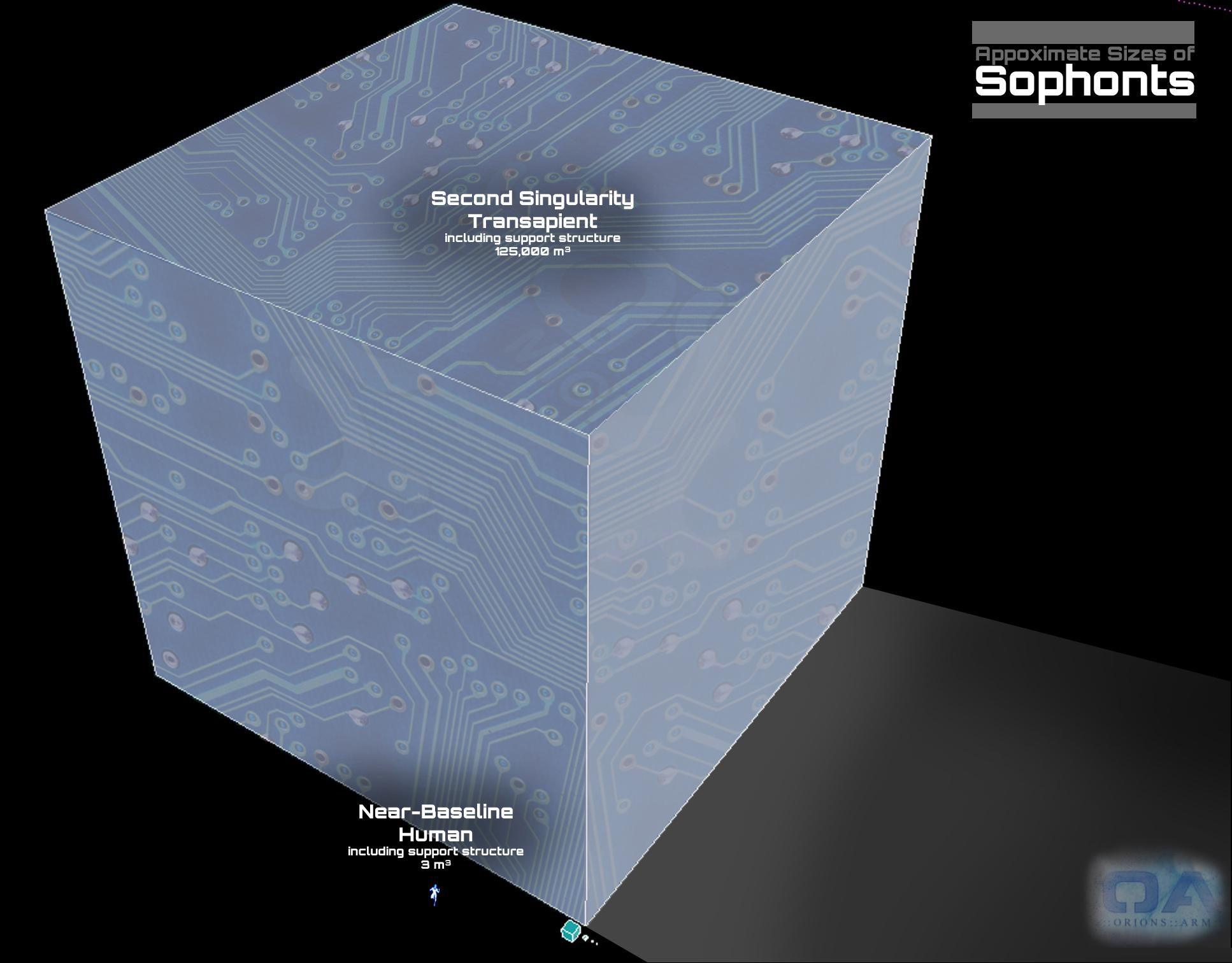 Image from Arik |
S0 Near-Baseline Human | |
| Substrate | Naturally evolved protoplasmic matrix consisting of hundreds of billions of electrochemical processing cells of various types. Uses a combiination of digital and analog computations to process sensory data from multiple input sources, regulate bodily functions, and support the mind-state of the near-baseline sophont. |
|---|---|
| Mass | Approx 1.5 kg |
| Volume | Approx 1500 cm3 |
| Dimensions | Approx 11.5 cm on a side if expressed as a cube |
| Speed | 1e18 ops/sec |
| Storage | 1e18 bits |
| Backup Data | Dimensions of backup modules: With triple redundancy a cube 3 mm on a side. Formed of memory diamond consisting of alternating carbon-12/13 atoms coding for one bit per pair, plus internal connectivity and support structures, I/O systems, etc. Total dimensions of backup module: Note that standard backups include compressed exoself data, lifelog metadata and a selection of favoured clade templates. Along with protective casing, I/O ports and distress beacons (for recovery in event of death) overall volume is increased to approximately 1 cm^3 |
S0 Turingrade AI | |
| Substrate | Typical example; nanotech diamondoid processor matrix employing a mix of molecular electronics and quantum computing to reproduce a modosophont level mind in a more compact and powerful substrate. As with biont brains, approximately 75% of mass is given over to non-processing components for safety and maintenance. |
|---|---|
| Mass | 527 g |
| Volume | 150 cm3 |
| Dimensions | Approximately 5.3 cm on a side if expressed as a cube |
| Speed | 1e18 ops/sec (variable and individually controllable) |
| Storage | 1e18 bits |
| Backup Data | Dimensions of backup modules: With triple redundancy a cube 3 mm on a side. Formed of memory diamond consisting of alternating carbon-12/13 atoms coding for one bit per pair, plus internal connectivity and support structures, I/O systems, etc. Total dimensions of backup module: Note that standard backups include compressed exoself data, lifelog metadata and a selection of favoured clade templates. Along with protective casing, I/O ports and distress beacons (for recovery in event of death) overall volume is increased to approximately 1 cm^3 |
S0 Superturingrade AI | |
| Substrate | Typical example; nanotech diamondoid processor matrix employing a mix of molecular electronics and quantum computing to produce a greater than human, but still modosophont level mind in a compact and powerful substrate. As with biont brains, approximately 75% of mass is given over to non-processing components for safety and maintenance. Superturings are often optimized via a combination of hardware and software for particular tasks and processing methods and display a wide range of designs, processor speeds, and toposophic structures reflecting this fact. The physical values provided here reflect a range of capability from Homo Superior to the most powerful sub-Singularity minds that modosophont technology can produce. |
|---|---|
| Mass | 580 g - 1.3 kg |
| Volume | 165 - 375 cm3 |
| Dimensions | Approximately 5.8cm - 7.2cm on a side if expressed as a cube |
| Speed | 1.1e18 - 1e20 ops/sec (variable and individually controllable) |
| Storage | 1.1e18 - 1e20 bits |
| Backup Data | Dimensions of backup modules: With triple redundancy a cube approx. 3.1 - 14.4 mm on a side. Formed of memory diamond consisting of alternating carbon-12/13 atoms coding for one bit per pair, plus internal connectivity and support structures, I/O systems, etc. Total dimensions of backup module: Note that standard backups include compressed exoself data, lifelog metadata and a selection of favoured clade templates. Along with protective casing, I/O ports and distress beacons (for recovery in event of death) overall volume is increased to approximately 1 - 125 cm3 |
S1 First singularity Hyperturing | |
| Substrate | Nanotechic diamondoid processor matrix developed by transapient level intelligences. Although superficially similar to modosophont designs, uses a variety of design and programming techniques that defy modosophont analysis and comprehension in most regards. These design enhancements permit a much greater than modosophont level of intelligence in a processor substrate that is comparatively only slightly larger. Similarly optimized biological equivalents to this processor are roughly 25% more massive and four times the volume of the diamondoid equivalent. |
|---|---|
| Mass | 55 kg |
| Volume | 15625 cm3 |
| Dimensions | Approximately 25 cm on a side |
| Speed | 1.56e22 ops/sec (variable and individually controllable) |
| Storage | 1.56e22 bits |
| Backup Data | Dimensions of backup modules: single molecular memory module 8814 mm3 or approximately 2.07 cm on a side. Total dimensions of backup module: With standard Backup triple redundancy functions, total unit is approximately 3 cm on a side. |
| Modosophont equivalents | Processing and storage substrates built with S1 technology but housing minds of lower S-level. Turingrade AI/Modosophont Upload Processor: 1 cm3 Turingrade AI/Modosophont Backup: 0.6 mm3 or 0.85 mm on a side. |
S2 Second Singularity High Transapient | |
| Substrate | Second Singularity intelligence is based upon the foundation of the so-called Ultimate Chip a diamondoid processor matrix of considerable power. While exact measurements are impossible to make, it is theorised that in general the portion of the S2 mind that is accessible to nearbaseline understanding displays an intelligence and range of capability perhaps 1e7 times that of a modosophont mind. The remainder of transapient processing capability is believed to be devoted to modes of thought and comprehension that have no modosophont equivalent. |
|---|---|
| Mass | 4,031 kg (not counting support structure) |
| Volume | 1,145,100 cm3 (not counting support structure) |
| Dimensions | Approximately 50 m on a side including support structure |
| Speed | 5.1e27 ops/sec (variable and individually controllable) |
| Storage | 5.1e27 bits |
| Backup Data | Dimensions of backup modules: 1.045 m3 or approximately 1.015 m on a side. Total dimensions of backup module: With standard Backup triple redundancy functions, total unit is approximately 1.46 m on a side. |
| Sub S2 Equivalents | Processing and storage substrates built with S2 technology but housing minds of lower S-level. S1 Processor/Backup: 3200 mm3 or 1.5 cm on a side. With triple redundancy functions, total unit is approximately 2.15 cm on a side. Note: Due to storage limitations it requires approximately 32 Ultimate Chip units to successfully run an S1 mind. Turingrade AI/Modosophont Processor/Backup: .215 mm3 or .6 mm on a side. With triple redundancy total unit is approximately .85 mm on a side. |
S3 Third Singularity Highest Transapient or Godling | |
| Substrate | Third Singularity intelligences generally make use of a 'hot' Ultimate Chip array, usually arranged as a Moon Brain, although other designs (cf. Banks Orbital, Matrioshka Micro-node) are not uncommon. While exact measurements are impossible to make, it is theorised that in general the portion of the S3 mind that is accessible to nearbaseline understanding displays an intelligence and range of capability perhaps 1e11 times that of a modosophont mind. The remainder of transapient processing capability is believed to be devoted to modes of thought and comprehension that have no modosophont equivalent. |
|---|---|
| Mass | 7e21 kg |
| Volume | 3.35e10 km3 |
| Dimensions | Approximately 2000 km radius including support structure |
| Speed | 2.97e38 ops/sec (variable and individually controllable) |
| Storage | 1.64e55 bits |
| Communication Rate | 5.12e40 bits/sec |
| Backup Data | As of this writing, there are few confirmed instances of Third Singularity entities being resurrected from Backup. Credible reports of the destruction of such entities are extremely rare and in all cases were the result of the efforts of equal or higher toposophic entities, making the survival of any hypothetical Backup extremely unlikely. Nevertheless this has happened on rare occasions. The sheer amount of data in the mind of an S:3 makes copying or backing-up a time consuming task. A typical S:3 has memory capacity of 1.64e45 bits, and a maximum bandwidth at the surface of 5.12e40 bits/sec. This means it would take nearly nine hours to transmit the S:3's mind to another location or copy it into a Backup and so on, if it does absolutely nothing else with its time, gets rid of all external sensors and replaces them with transmitters, transmitting in all directions at once. This is not very practical, although physically possible. |
| Sub S3 Equivalents | Processing and storage substrates built with S3 technology but housing minds of lower S-level. Third Singularity storage and processing technology that has been made available to lower S-levels seems to use hardware that is effectively identical to Second Singularity systems, although the software running on it is routinely far more efficient and capable. Whether these apparent limits on hardware are the result of some actual limit, perhaps imposed by temperature or shielding issues, or represent a policy decision by higher toposophics is unknown at this time. |
Related Articles
- Archailect Architecture
- Bimodal Toposophy
- Brain Taxonomy
- Computronium
- Great Toposophic Filter, The
- Membranotoposophy - Text by M. Alan Kazlev
Important subset of toposophy which maps transapient and similar cognitive states in terms of surfaces rather than as a linear scale or even a branching tree. - Slow Gods and Fast Gods
- Sovereign, Toposophic
- TAID (Toposophic Ascension Identity Disassociation)
- Toposophic Levels and Mental Abilities
- Toposophics Diversification Conjectures
- Ultimate Chip
- Upload
Appears in Topics
| Computronics | First Toposophic - Basic Transapients | Modosophonts |
| Second Toposophic - High Transapients | Singularity Levels | Toposophic Scales |
Development Notes
Text by Todd Drashner
Initially published on 23 October 2006.
superturing S0 section added after 2011
Brain scale Illustrations by Arik added 2016
Processing power, computation stats, and ultimate chips revised November 2020 by Todd Drashner and Gabrielle of Gaussia
Initially published on 23 October 2006.
superturing S0 section added after 2011
Brain scale Illustrations by Arik added 2016
Processing power, computation stats, and ultimate chips revised November 2020 by Todd Drashner and Gabrielle of Gaussia






